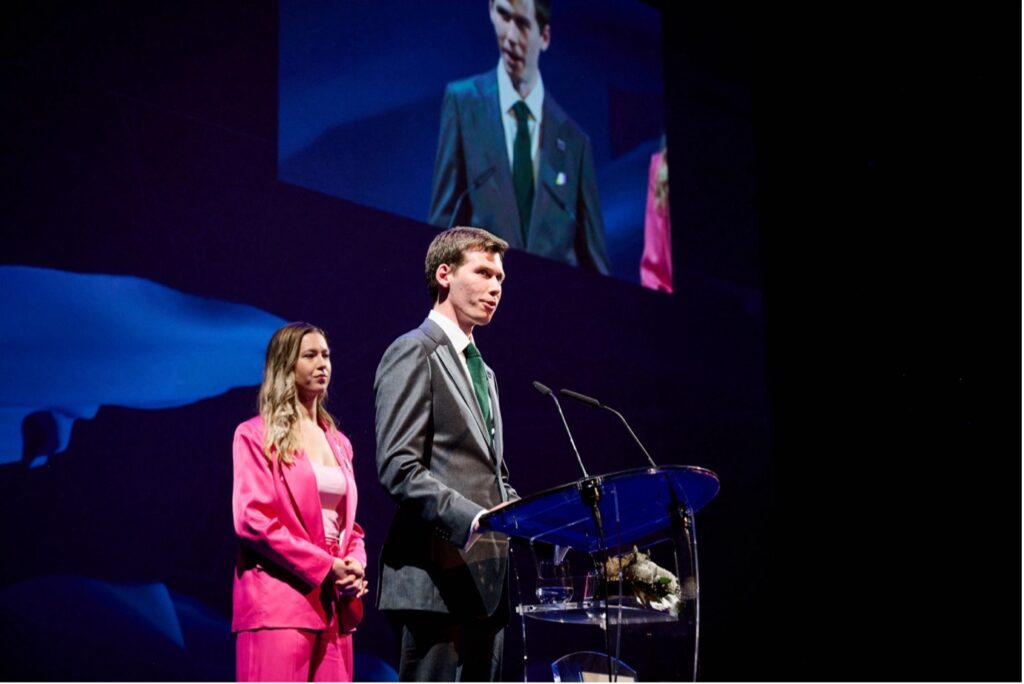
I am proud to announce that following the nomination of the British Youth Council, I will be standing for re-election to the Council of Europe’s Advisory Council on Youth for the 2026-2027 mandate this May.
When I announced my candidacy two years ago, I highlighted three core values: (1) the urgency of addressing shrinking civic space, (2) the link between non-formal education funding and revitalising democratic values, and (3) the protection of minorities, especially young migrants and asylum seekers. My campaign focused on creating an ”inclusive, peaceful and democratic Europe”, highlighting the need for the Advisory Council on Youth to engage more proactively and communicate its efforts to better empower young people.
Two years on, these priorities still shape my work in the Advisory Council on Youth today.
Recent developments, notably the near-collapse of the British Youth Council in Spring 2024, underscore the urgency of addressing shrinking civic space trends. If a 75-year-old organisation can face such a crisis, no youth organisation is immune—particularly in political climates where funding is restricted, where youth activists face persecution or where governments create parallel youth structures to hollow out the democratic independence of youth civil society. This represents not just a threat for youth organisations but a dangerous void in which populism can flourish, allowing partisan extremists to exploit political grievances, scapegoat minorities, and curtail young people’s freedoms.
At a time when member States should reinforce their commitments to human rights, democracy, and the rule of law—the Council of Europe’s core pillars—many are instead attempting to roll back the protections offered by institutions like the European Court of Human Rights. Meanwhile, important issues affecting young people, such as housing, the cost of living, and labour market pressures, have not received adequate attention.
As a result, it’s no wonder why the old tale that ‘young people are progressive’ no longer applies. Today, the picture is more complicated as young people’s faith in democracy wanes. Instead, young men in particular are being pushed to political extremes, falling victim to hate speech and misinformation online and offline.
While the world may seem upside down, there is hope.
The Council of Europe’s Youth Department has a 50-year tradition of creating space for young people. Through training seminars and initiatives like the ”Democracy Here. Democracy Now” campaign, it has fostered transnational youth engagement from its youth centres in Strasbourg and Budapest and even into Ukraine, providing vital support for youth workers during ongoing conflict.
Additionally, through co-management, the Advisory Council on Youth, together with ministerial representatives, have been able to co-write recommendations on a range of youth matters, from shrinking civic space to the protection of National Youth Councils, the role of young climate defenders and the socio-economic inclusion of rural youth—the last two being major achievements of this mandate.
These recommendations are more than just words; once adopted, they become soft laws that set standards for member States to uphold.
But that’s not all.
The Reykjavík Declaration has ignited a renewed focus on the ‘Youth Perspective,’ a crucial outcome of the 4th Summit of Heads of State and Government of the Council of Europe in May 2023. With a Youth Ministerial conference on the horizon, 2025 is poised to be a watershed moment for the Youth Department, presenting the European youth sector with a prime opportunity to elevate youth participation within the institution and at national levels.
As I seek a second mandate, I am committed to collaborating with partners across Europe, including the European Youth Forum, to ensure the robust fight for youth rights continues.
Serving as a member and Vice-Chair of the Advisory Council on Youth is a privilege of a lifetime, and I would be honoured to continue this work in a second mandate.
But let me be clear—if re-elected, I will not simply be a continuity candidate. I will harness the momentum from Reykjavík and this year’s ministerial conference in Malta to boldly advance the youth social rights agenda, linking it to essential intergovernmental efforts, such as the Secretary General’s Action Plan on the Renewal of Democracy.
If you represent a European Youth Forum member organisation, expect to hear from me in the coming months to share more about my campaign platform. Likewise, if you are a member of one of the European Youth Forum’s member organisations, I would love to hear your ideas. Please get in touch: mcuttin13@icloud.com
Lastly, I would like to state my sincerest gratitude to the British Youth Council membership, together with the National Youth Agency, for re-nominating me; it means the world!
