We are leading a 10-year Workforce Transformation Plan to strengthen youth work in England. The plan supports the ambitions set out in Youth Matters: Your National Youth Strategy and focuses on workforce supply, skills, standards and professional recognition.
Workforce Transformation Plan

The National Youth Agency believes that all young people who need it should be able to access the safe and trusted support of a youth worker.
Youth workers help young people learn essential life skills, stay safe and well, as well as instil in them a sense of belonging and purpose which strengthens local communities. With young people facing complex and increasing challenges such as social isolation, poor mental wellbeing, online harm, the cost-of-living crisis and global uncertainty, the need for more youth workers who are better equipped to meet young people’s needs cannot be understated.
The NYA is committed to evidencing the impact and value of youth work and has informed the government’s Youth Matters: Your National Youth Strategy, published in December 2025.
Youth Matters recognises the vital role youth workers play in keeping young people safe and well and developing their essential life skills. It aims to connect 500,000 more young people in England with a trusted adult outside their home by 2035.
It sets out the need for a skilled, sustainable youth work workforce with high standards and commits to clearer career routes, better recognition and more accessible training for paid and volunteer youth workers, alongside more diverse entry routes and clearer career progression.
Within the strategy the government earmarked funding of around £85 million, comprising:
- £15 million over three years in youth workers, volunteers and other trusted adults – supporting recruitment and retention through training and qualification bursaries, safeguarding, volunteer support and digital skills
- nearly £70 million to support local youth service transformation, including up to 50 Young Futures Hubs by March 2029.
NYA’s Workforce Transformation Plan provides the mechanism to ensure that the youth work sector has the capacity and skills to meet the ambitions of Youth Matters.
The strategy also encourages local authorities and the voluntary sector to work with young people to design services locally, alongside efforts to unlock match funding and local philanthropy.
The state of the youth sector
A decade of funding cuts has resulted in 4,500 youth work roles being lost, reduced job stability and fewer opportunities for progression, making it harder to deliver coordinated support across services.
Workforce shortages mean that many young people are lacking the support of suitably trained youth workers and the impact of this is particularly felt by those in marginalised or under-served areas.
At the time of developing the Workforce Transformation Plan in late 2025, the youth work sector consisted of an estimated:
- 21,150 paid youth workers
- 14,350 volunteers
- 4,350 youth workers qualified to Level 6 or above (professional youth worker)
- 4,200 youth workers qualified to Level 2-3
The NYA’s latest Youth Sector Census snapshot data and Annual Workforce Survey reveal that:
- recruitment remains a major challenge, especially for suitably qualified youth workers
- the workforce is ageing, with 75% of workers aged over 36 years
- training gaps persist in digital youth work, media literacy, impact measurement and peer supervision
- job security and access to resources continue to limit confidence and sustainability.
Strengthening the youth work workforce is pivotal to delivering the ambitions of the National Youth Strategy.
Find out more about youth work qualifications and the funding available through apprenticeships and bursaries. There’s also a suite of CPD available via the NYA Academy to help boost your skills and confidence as well as make your team feel valued.
Our Workforce Transformation Plan
Our 10-year Workforce Transformation plan (until 2036) sets out how we will grow and strengthen the youth sector workforce to meet the needs and aspirations of young people in England and achieve the targets set out in the National Youth Strategy.
It consists of three streams of work:
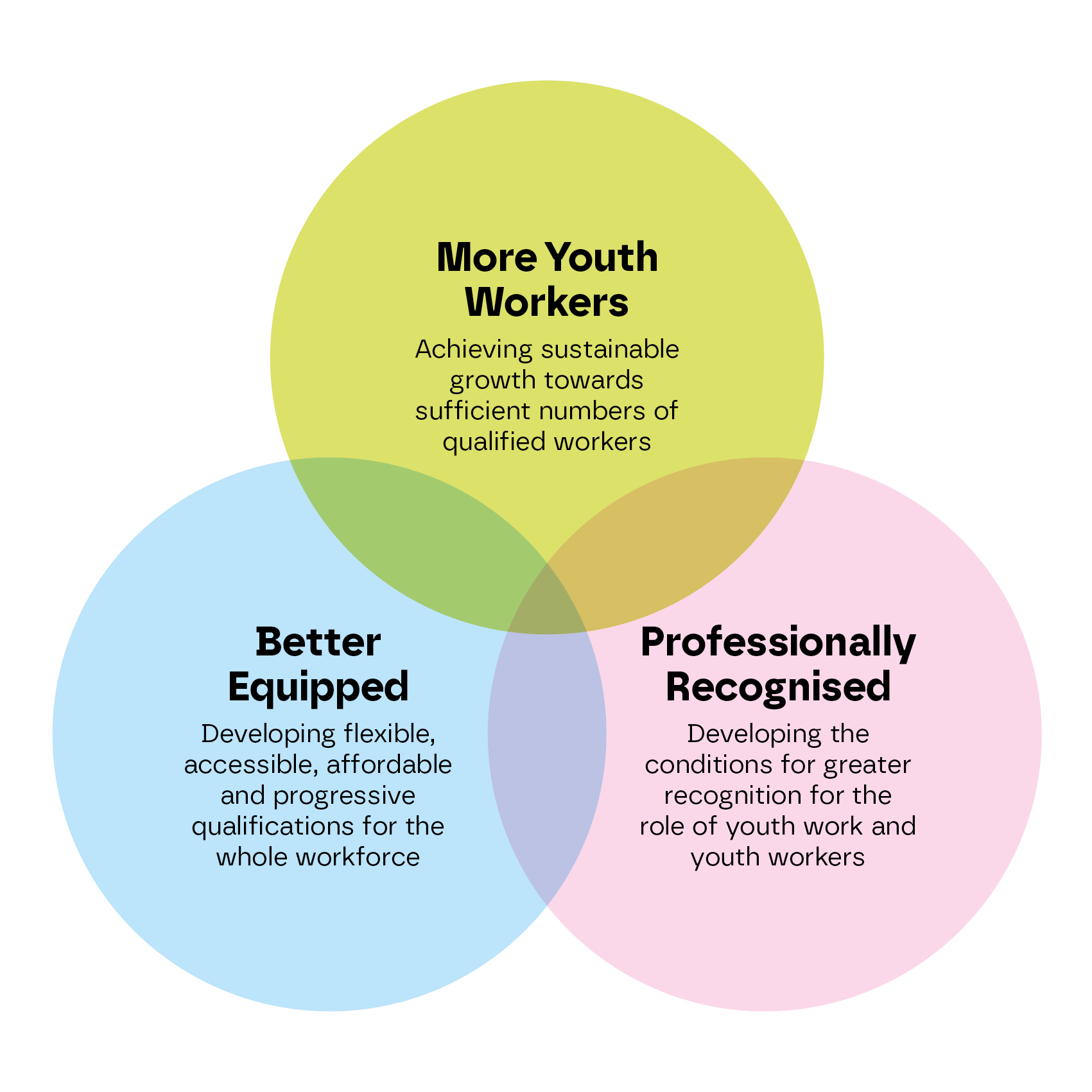
More Youth Workers
we will work to achieve sustainable growth towards sufficient numbers of trained and qualified workers at all levels and settings, including volunteers and trusted adults, youth work practitioners through to professionally qualified and experienced youth workers.
Better Equipped
we will renew the youth work qualifications pathway for youth sector workers to ensure that high-quality training is available at the right time and in the right place, providing flexible, accessible, affordable and progressive qualifications for the whole workforce.
Professionally Recognised
we will work to secure greater recognition for the role of youth work and youth workers. This will address the recognition of the workforce, including youth worker registration, status, support, progression and continuing professional development.
What does sufficient looks like?
We define a sufficient workforce as one professionally qualified youth worker and two youth workers qualified at levels 2 – 5 for every 500 young people -supported by at least two trained volunteers. That’s roughly one trained and qualified worker per 100 young people.
At the time of developing our plan youth sector capacity was less than 25% of what is needed to meet this ratio and our Annual Workforce Survey suggested that there was around one professionally qualified youth worker plus one additional qualified worker (Levels 2–3) for every 1,500 young people.
There are approximately 8,400 qualified youth workers currently, and NYA’s ambition is to more than double that to 19,500 qualified workers at Levels 1–6 in the next ten years. This includes 6,500 Level 6 – 7 workers. In the same period, we aim to equip at least 13,000 volunteers and trusted adults with ‘essential training’, including those in allied sectors (for example, sport and uniformed groups).
Why reform of the qualification framework is needed
Evidence shows that the current youth work qualification system is not suitable to provide the growth needed in Youth Work:
Widespread lack of qualifications
60% of youth workers don’t hold a recognised qualification. Of 21,150 paid youth workers, only 4,350 are qualified to Level 6 (professional status) and 4,200 to Level 2 or 3 (support worker level). Fewer than 25% are on JNC terms.
Barriers to training
Cost, access and inconsistent quality make it hard for part-time and short-term staff to train locally or affordably.
Shrinking pathways
Just 6 of the 17 undergraduate courses from 2013 remain, with record-low enrolment. Entry requirements often exclude those with lived experience or community leadership backgrounds.
Limited career progression
The jump from Level 3 to Level 6 is steep – due to cost, time and entry criteria. The new framework introduces a smoother, more inclusive pathway.
Growing demand
Young people need skilled youth workers more than ever. Government initiatives like the National Youth Strategy, Local Youth Transformation Pilots and Young Futures Programme are expanding opportunities.
Future outlook
Youth work is projected to be one of the UK’s fastest-growing professions by 2035 (NFER: The Skills Imperative 2035).
The new qualification framework

Building on sector consultation which informed the Pathways to Practice recommendations (April 2025), NYA is supporting a redesigned, Standard Qualification Framework. This means changing certain youth work qualifications and the introduction of new ones, creating clear recognition at each level and a universal pathway towards professionally qualified status.
The framework will inform the development of ‘essential training’ for volunteers and trusted adults, alongside qualifications from Level 1 to Level 6. Anyone working with young people may complete the ‘essential training’ to demonstrate that they have the baseline of skills and competencies to provide safe and trustworthy support to young people.
Training, qualifications and apprenticeships will be modernised to create clearer, more flexible routes into youth work, and each level will be mapped to roles, responsibilities and expectations.
Key aspects of the new qualification framework:
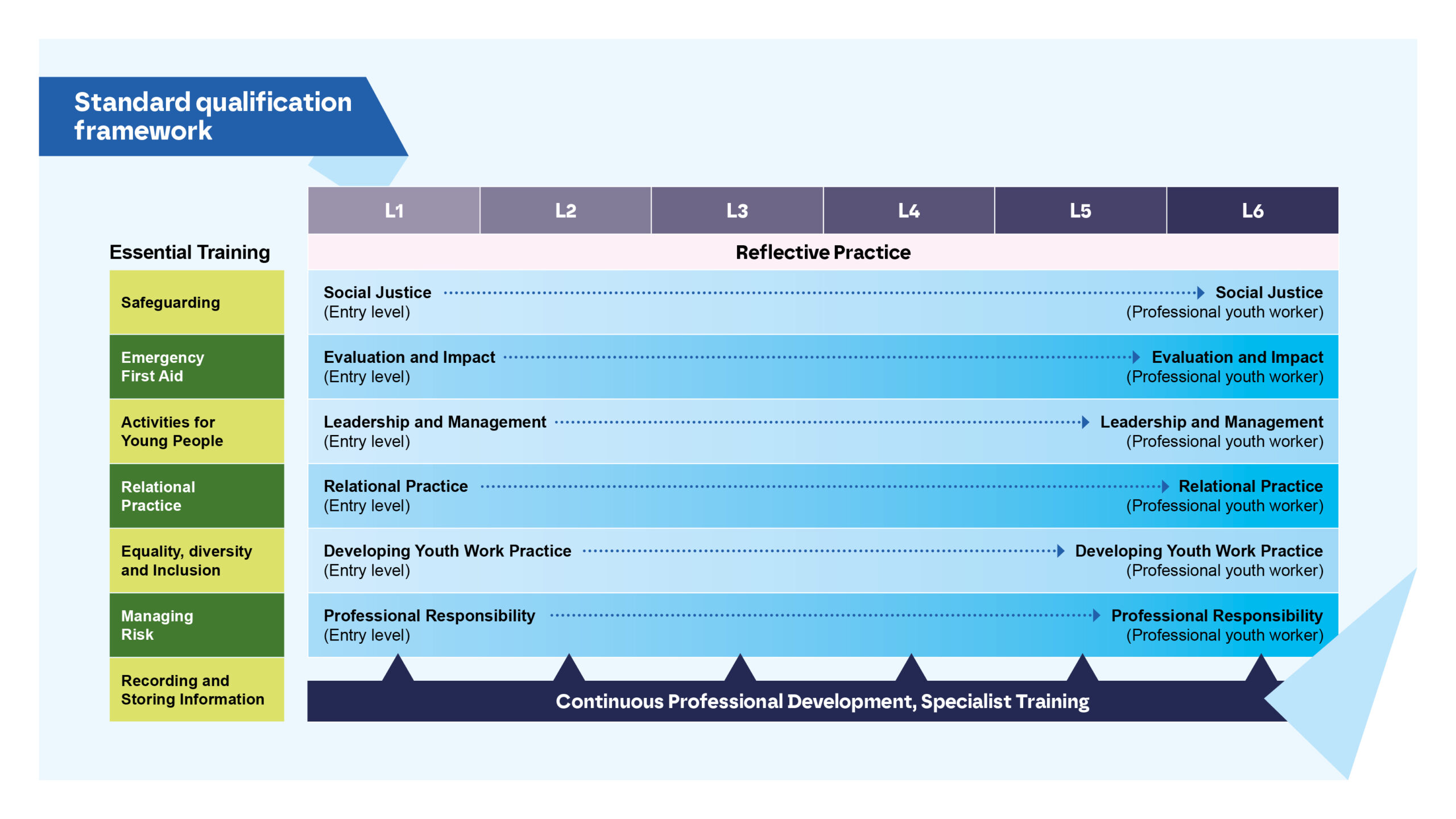
- modular learning to build essential youth work skills and enables completion of individual units as stepping-stones to qualifications
- clear progression from entry level to degree level, with Levels 1- 5 building competence, confidence and practical experience, and Level 6+ remaining the gold standard conferring professional status
- alignment with the National Occupational Standards, Practice and Safeguarding Standards, Youth Work Curriculum, and youth work values
- an ambition to introduce higher technical qualifications to support progression- subject to the outcomes of wider government education reforms
- more flexible, accessible and affordable training routes
- recognition of prior experience and learning.
Professional recognition and the conditions for success
Professional recognition is essential for sustainability, supporting clearer standards, accountability and progression across the sector, and positioning youth work alongside other professions in education, social care and health.
Alongside qualification reform, we are working to improve the structural and regulatory conditions that support a resilient, high-quality youth work workforce. Our priorities include:
- broadening the Youth Worker Register beyond Level 6+ to promote greater consistency, quality and safety across the sector and to give all youth workers recognition for their skills and qualifications, and something they can be proud to be part of. This aligns with the National Youth Strategy ambitions set out by the government
- clarifying regulatory guidance within Local Authorities’ Statutory Duty to support a sufficient local youth work offer
- sharing models of good practice across local authorities and partners
- improving employer guidance and standards so youth workers are supported to deliver safe, high-quality practice
- expanding access to CPD to support retention, development and professional confidence.
”“Reform of the qualification framework is vital to rebuild the youth work sector and meet the ambitions of the National Youth Strategy. We are working closely with awarding organisations, training providers, employers, funders and commissioners to develop the new qualifications which will help us build back the workforce at the speed needed to meet demand.
“The aim is to attract new people into this hugely rewarding profession, upskill the current workforce and create affordable, accessible routes into qualifications and training, while protecting youth work values and accrediting essential skills.”
Abbee McLatchie,Director of Youth Work/Deputy CEO, National Youth Agency
When will the new framework be up and running?
We are working with the Awarding Bodies Network, Higher and Further Education institutions and youth work trainers to bring about the changes to the youth work qualifications. An indicative timetable is set out below:
- the reformed Level 1 and Level 2 qualifications are expected to be available from Autumn 2026
- a new Level 3 Technical Occupational Entry in Youth Support Work (Diploma) will launch on 1 August 2026 mapped to the Occupational Standard for Youth Support Worker Apprenticeship Framework*. It is anticipated that this qualification will become the mandatory qualification for the Youth Support Worker apprenticeship
*Skills England has Occupational Standards for Youth Support Worker and Youth Worker. In time, NYA is planning to develop Occupational Standards for Levels 3-6 in Youth Work.
- we are working to ensure that there will be funded routes to qualification at Levels 2 – 6 and for training for volunteers, allowing workers to receive free or greatly subsidised training. The apprenticeship offers this already at levels 3 and 6, and once the Department for Education has completed its education reforms, we will look to create funded qualifications at Levels 2,3,4 and 5 – which could include a V-Level and Higher Technical Qualifications. We are also working to allow youth workers to access the proposed new Skills Levy and Lifelong Learning Entitlement to fund Youth Work Training
- from 2027, the NYA will publish an Annual Sector Qualifications Report tracking uptake, delivery capacity, outcomes and workforce impact.
”“Youth work plays a vital role in supporting young people’s wellbeing, life skills and safety, but for too long it has been delivered under the radar, with scant funding or recognition.
“The National Youth Strategy provided the mandate for a stronger and better qualified workforce and for recognising the value and impact of youth workers in the youth ecosystem, working alongside allied professionals in education, social care and health.
“Qualification reform is essential to meet demand, but it must be part of a wider package of change across the youth sector. Lasting impact relies on clear sufficiency benchmarks being set out in the Statutory Duty to show what a properly resourced youth offer looks like - and on sustainable funding for Local Authorities to deliver it in partnership with the voluntary sector.
“Alongside developing the revised Standard Qualification Framework we will continue to work with government, policy makers and the sector to help catalyse change locally and to promote models of good practice across local authority areas.”
Leigh Middleton OBECEO, National Youth Agency
Contact
If you have any questions about the proposed new qualification framework please email: nya@nya.org.uk