We are leading a 10-year Workforce Transformation Plan to strengthen youth work in England. The plan supports the ambitions set out in Youth Matters: Your National Youth Strategy and focuses on workforce supply, skills, standards and professional recognition.
Workforce Transformation Plan

The National Youth Agency believes that all young people who need it should be able to access the safe and trusted support of a youth worker.
Youth workers help young people learn essential life skills, stay safe and well, as well as instil in them a sense of belonging and purpose which strengthens local communities. With young people facing complex and increasing challenges such as social isolation, poor mental wellbeing, online harm, the cost-of-living crisis and global uncertainty, the need for more youth workers who are better equipped to meet young people’s needs cannot be understated.
The NYA is committed to evidencing the impact and value of youth work and has informed the government’s Youth Matters: Your National Youth Strategy, published in Rhagfyr 2025.
Youth Matters recognises the vital role youth workers play in keeping young people safe and well and developing their essential life skills. It aims to connect 500,000 more young people in England with a trusted adult outside their home by 2035.
It sets out the need for a skilled, sustainable youth work workforce with high standards and commits to clearer career routes, better recognition and more accessible training for paid and volunteer youth workers, alongside more diverse entry routes and clearer career progression.
Within the strategy the government earmarked funding of around £85 million, comprising:
- £15 million over three years in youth workers, volunteers and other trusted adults – supporting recruitment and retention through training and qualification bursaries, safeguarding, volunteer support and digital skills
- nearly £70 million to support local youth service transformation, including up to 50 Young Futures Hubs by Mawrth 2029.
NYA’s Workforce Transformation Plan provides the mechanism to ensure that the youth work sector has the capacity and skills to meet the ambitions of Youth Matters.
The strategy also encourages local authorities and the voluntary sector to work with young people to design services locally, alongside efforts to unlock match funding and local philanthropy.
The state of the youth sector
A decade of funding cuts has resulted in 4,500 youth work roles being lost, reduced job stability and fewer opportunities for progression, making it harder to deliver coordinated support across services.
Workforce shortages mean that many young people are lacking the support of suitably trained youth workers and the impact of this is particularly felt by those in marginalised or under-served areas.
At the time of developing the Workforce Transformation Plan in late 2025, the youth work sector consisted of an estimated:
- 21,150 paid youth workers
- 14,350 volunteers
- 4,350 youth workers qualified to Level 6 or above (professional youth worker)
- 4,200 youth workers qualified to Level 2-3
The NYA’s latest Youth Sector Census snapshot data and Annual Workforce Survey reveal that:
- recruitment remains a major challenge, especially for suitably qualified youth workers
- the workforce is ageing, with 75% of workers aged over 36 years
- training gaps persist in digital youth work, media literacy, impact measurement and peer supervision
- job security and access to resources continue to limit confidence and sustainability.
Strengthening the youth work workforce is pivotal to delivering the ambitions of the National Youth Strategy.
Find out more about youth work qualifications and the funding available through apprenticeships and bursaries. There’s also a suite of CPD available via the NYA Academy to help boost your skills and confidence as well as make your team feel valued.
Our Workforce Transformation Plan
Our 10-year Workforce Transformation plan (until 2036) sets out how we will grow and strengthen the youth sector workforce to meet the needs and aspirations of young people in England and achieve the targets set out in the National Youth Strategy.
It consists of three streams of work:
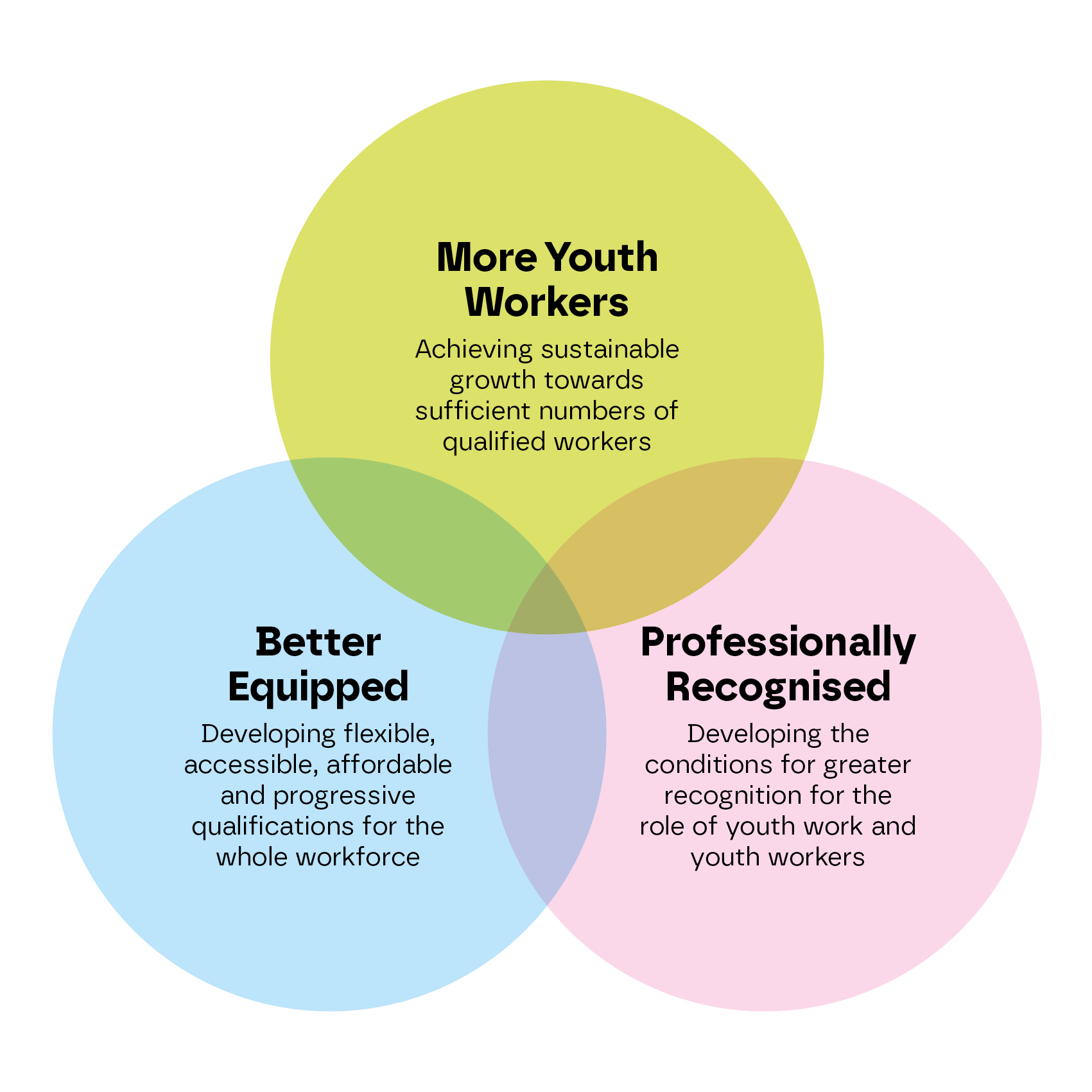
More Youth Workers
we will work to achieve sustainable growth towards sufficient numbers of trained and qualified workers at all levels and settings, including volunteers and trusted adults, youth work practitioners through to professionally qualified and experienced youth workers.
Better Equipped
we will renew the youth work qualifications pathway for youth sector workers to ensure that high-quality training is available at the right time and in the right place, providing flexible, accessible, affordable and progressive qualifications for the whole workforce.
Professionally Recognised
we will work to secure greater recognition for the role of youth work and youth workers. This will address the recognition of the workforce, including youth worker registration, status, support, progression and continuing professional development.
What does sufficient looks like?
We define a sufficient workforce as one professionally qualified youth worker and two youth workers qualified at levels 2 – 5 for every 500 young people -supported by at least two trained volunteers. That’s roughly one trained and qualified worker per 100 young people.
At the time of developing our plan youth sector capacity was less than 25% of what is needed to meet this ratio and our Annual Workforce Survey suggested that there was around one professionally qualified youth worker plus one additional qualified worker (Levels 2–3) for every 1,500 young people.
There are approximately 8,400 qualified youth workers currently, and NYA’s ambition is to more than double that to 19,500 qualified workers at Levels 1–6 in the next ten years. This includes 6,500 Level 6 – 7 workers. In the same period, we aim to equip at least 13,000 volunteers and trusted adults with ‘essential training’, including those in allied sectors (for example, sport and uniformed groups).
Why reform of the qualification framework is needed
Evidence shows that the current youth work qualification system is not suitable to provide the growth needed in Youth Work:
Diffyg cymwysterau eang
Nid oes gan 60% o weithwyr ieuenctid gymhwyster cydnabyddedig. O blith 21,150 o weithwyr ieuenctid cyflogedig, dim ond 4,350 sydd â chymwysterau Lefel 6 (statws proffesiynol) a 4,200 i Lefel 2 neu 3 (lefel gweithiwr cymorth). Mae llai na 25% ar delerau JNC.
Rhwystrau i hyfforddiant
Mae cost, mynediad ac ansawdd anghyson yn ei gwneud hi'n anodd i staff rhan-amser a thymor byr hyfforddi'n lleol neu'n fforddiadwy.
Llwybrau crebachu
Dim ond 6 o'r 17 cwrs israddedig o 2013 sydd ar ôl , gyda nifer y myfyrwyr sy'n cofrestru ar ei lefel isaf erioed. Yn aml, nid yw gofynion mynediad yn cynnwys y rhai sydd â phrofiad personol neu gefndiroedd arweinyddiaeth gymunedol.
Datblygiad gyrfa cyfyngedig
Mae'r naid o Lefel 3 i Lefel 6 yn serth – oherwydd cost, amser a meini prawf mynediad. Mae'r fframwaith newydd yn cyflwyno llwybr llyfnach a mwy cynhwysol.
Galw cynyddol
Mae angen gweithwyr ieuenctid medrus ar bobl ifanc yn fwy nag erioed. Mae mentrau llywodraeth fel y Strategaeth Ieuenctid Genedlaethol, Cynlluniau Peilot Trawsnewid Ieuenctid Lleol a Rhaglen Dyfodol Ifanc yn ehangu cyfleoedd.
Rhagolygon y dyfodol
Rhagwelir y bydd gwaith ieuenctid yn un o'r proffesiynau sy'n tyfu gyflymaf yn y DU erbyn 2035 (NFER: The Skills Imperative 2035).
Details of the Standard Qualification Framework will be published in the Autumn. Please watch this page for details.
Cyswllt
If you have any questions about the proposed new qualification framework please email: nya@nya.org.uk