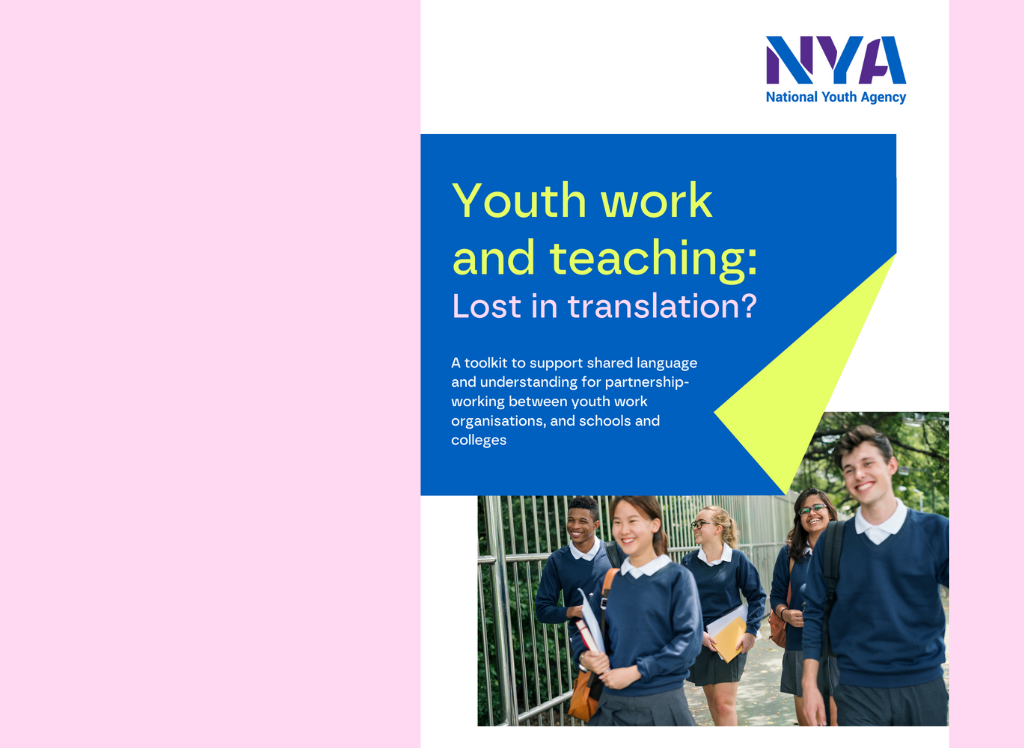

The National Youth Agency (NYA) has produced a toolkit to help strengthen collaboration between youth work organisations, and secondary schools and colleges in order improve pupil wellbeing, engagement with learning and support safeguarding. Youth work and teaching: Lost in translation? A toolkit to support shared language and understanding for partnership-working between youth work organisations, and schools and colleges is aimed at practitioners and those commissioning interventions for young people within schools, academy trusts and colleges.
The resource responds to the rise in persistent absenteeism since the pandemic, with an absence rate in state funded secondary schools of 8% during the school year 2023-41, Unmet mental health and SEND needs, and pupils whose families are experiencing poverty may have difficulty engaging with learning due to the stress of the challenges they are experiencing. Whilst teachers may recognise changes in a pupil’s behaviour or safeguarding concerns, their focus is on teaching and many lack the time needed to understand the contextual circumstances around a young person and to provide the dedicated support by a trusted adult to overcome the barriers to learning they face.
The impact of youth workers in a further education setting is highlighted in the resource through an evaluation of the STEPs programme at Derby College. The study, by the University of Derby between 2019 – 23, found an increased retention rate of students by 6.25% and an almost triple the number of disclosures made to college staff. Parents also highlighted the benefits of their children having access to a dedicated trusted adult to discuss their problems with.
One parent cited in the research said: “As a mother I’m in that category in terms of how he sees me. I was seen as an authority figure who he couldn’t talk to about certain things and I know for a fact he talked to [youth worker] about things he couldn’t with me, and I was massively grateful that he had someone to talk to.
“If he hadn’t had somebody there at that time in his life, like [a youth worker] and if the college wasn’t keeping me informed, he might be dead by now. It is that bad.”
The toolkit sets out the educational process which underpins youth work practice informed by the National Youth Work Curriculum and how this flexible framework enables youth workers to develop young people’s personal, social and emotional skills, nurture their interests and sense of belonging in their community and remove barriers to learning.
Youth workers provide young people with a safe space to discuss the wider issues affecting them, such as family breakdown and the risk of exploitation, as well as providing opportunities to enrich their employability and life skills. It can be particularly effective in supporting young people at key transitions, for example moving up to secondary school and leaving formal education.
The new resource for schools and colleges aims to dispel some of the myths around youth work, as well as highlight the shared responsibilities of youth workers and education institutions, for example around preparing young people for employment, supporting their health and wellbeing and keeping them safe. It emphasises the need for parity of esteem between youth workers and teaching staff and highlights the professional training which youth workers receive. It also provides a simple guide to help schools and youth work organisations to form an effective partnership.
”“With statutory services unable to meet with demand for mental health support, and the epidemic of non-attendance, there’s no doubt that young people are desperately in need of earlier interventions to overcome the myriad challenges they are facing.
“Where youth work is taking place in secondary schools and colleges it is proving effective in giving young people vital access to the safe spaces and support they need to overcome barriers affecting their engagement with learning, whilst allowing teachers to focus on teaching. Through the whole-person approach which youth workers take, youth work integrated in education is proven to improve attendance, reduce disruption in the classroom and increase safeguarding disclosures.”
Harriet McCannDirector of Policy and Communications, National Youth Agency
The resource builds on the NYA’s independent review of the impact of youth work delivered with schools which resulted in their Better together: Youth work with schools report published in June 2023, which evidenced the positive impact of youth work in and with schools on young people’s wellbeing, as well as promoting their safety and supporting community cohesion.
Youth work and teaching: Lost in translation?
Download the toolkit.