The SQF supports learners, employers and training providers by creating clearer progression opportunities, consistent expectations and stronger links between learning, professional practice and workforce needs.
Standard Qualification Framework (SQF) for Youth Work

The Standard Qualification Framework (SQF) for Youth Work creates clearer and more accessible routes into and through the profession, helping people enter youth work, develop their careers and progress towards professionally qualified status. It provides a clear structure for qualifications, workforce development and professional progression across youth work in England.
Why is the SQF needed?
The new Standard Qualification Framework (SQF) creates clearer, more accessible routes into and through youth work. Developed following sector consultation and the recommendations laid out in Pathways to Practice, it addresses barriers to progression through the previous qualification pathway and gives learners, practitioners, employers and training providers a clearer benchmark of the skills and standards expected at every level.
With demand for skilled youth workers growing, the SQF supports a stronger, more sustainable workforce. Its flexible, modular approach enables people to enter at different points, build on existing experience and progress through qualifications, apprenticeships, higher education and continuing professional development.
It also strengthens professional recognition, helping employers invest confidently in training and enabling more practitioners to build rewarding, long-term careers supporting young people.
Qualification pathway
The SQF provides a structured progression route from introductory learning through to professionally qualified youth worker status. Learners can enter at different points and progress through qualifications, apprenticeships, higher education and continuing professional development.
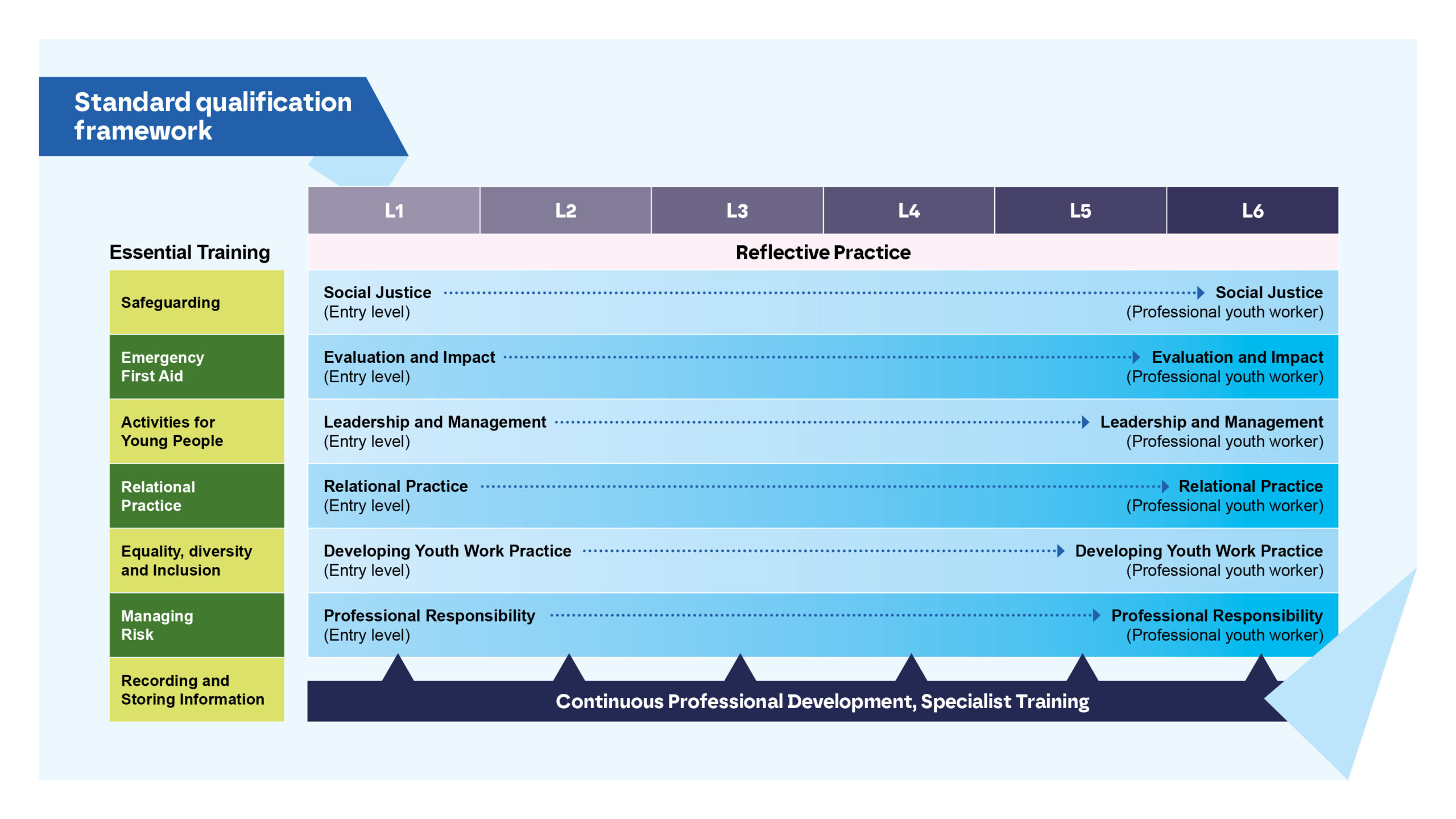
Click below to read the overview and view the full SQF and qualification pathways:
Our targets for workforce growth by 2035?
By 2035, the Workforce Transformation Plan aims to grow the Youth Work Workforce to:
- 6,500 professionally qualified youth workers (Levels 6-7), providing strategic leadership, specialist services, training and workforce development.
- 6,500 qualified youth workers (Levels 3-5), leading youth work sessions, projects and direct provision for young people.
- 6,500 qualified youth work practitioners (Levels 1-2), delivering youth work and wider activities under appropriate supervision.
- 13,000 trained volunteers and trusted adults, equipped through Essential Training to support young people safely and effectively.
Together, these ambitions would create a workforce of 19,500 qualified youth workers and practitioners, alongside 13,000 trained volunteers and trusted adults, representing a significant step towards the NYA’s long-term vision for workforce sufficiency and the Government’s ambition to ensure more young people have access to a trusted adult.
How will the SQF help me?

Students and learners
The SQF provides a clear pathway into and through youth work training, helping learners understand what is expected at each stage of development and identify routes into employment, further study and professional practice.

Employers
The SQF provides a common framework for workforce development, helping define role expectations, support staff progression and build a skilled, confident and professionally recognised workforce.

Education and training providers
The SQF provides a clear structure for curriculum design and qualification development, helping ensure learning remains aligned with sector expectations, professional practice and workforce needs.
Key principles of the SQF

Progression
The SQF provides a structured journey from introductory engagement through to advanced professional practice, with each level building on the last.

Professionalisation
The framework supports youth work as a recognised profession, with defined standards, responsibilities and expectations at every level.

Consistency
By aligning qualifications, roles and expectations, the SQF supports greater consistency across the sector while maintaining flexibility in delivery.

Practice-based learning
Learning is grounded in real youth work practice, ensuring qualifications remain relevant and applicable in workplace settings.
Qualification rollout
Available now
- Level 1 Award in Youth Work
- Level 3 Technical Occupational Entry in Youth Support Work (Diploma)
- Level 3 Youth Support Worker Apprenticeship
Coming next
- Reformed Level 2 qualification
- Level 4 pathway
- Level 5 pathway
Professionally qualifying routes
- Level 6 BA (Hons)
- Level 6 Youth Worker Apprenticeship
- Level 7 MA / PG Dip
”The new framework will open up clearer, more accessible routes to recognised qualifications for people already working in youth work, as well as those looking to enter this incredibly rewarding and varied growth sector. By setting clear expectations at every level, it will help practitioners build on their experience, progress their careers and gain the professional recognition they deserve - strengthening a skilled, confident workforce that can deliver the best possible support for young people.”
Kevin JonesHead of Workforce, National Youth Agency
Frequently Asked Questions
What happens to existing qualifications?
Existing youth work qualifications and professional achievements remain recognised. The SQF builds on established qualification pathways, including apprenticeships, higher education and professionally qualifying routes, while introducing new and updated qualifications that create clearer progression opportunities.
Do I need to gain a new qualification?
Not necessarily. The framework helps practitioners understand how existing qualifications, experience and training align with professional progression routes.
How do apprenticeships fit within the SQF?
Apprenticeships provide valuable earn-and-learn routes into youth work and sit alongside other qualification pathways within the framework.
What are Levels 6 and 7?
Level 6 (BA Hons), the Level 6 Youth Worker Apprenticeship and Level 7 (MA/PG Dip) all lead to professionally qualified status. Postgraduate routes involve a higher level of academic study and critical analysis.
How does the SQF support workforce development?
The SQF creates clearer routes into qualifications and professional development, helping attract new entrants while supporting existing practitioners to progress throughout their careers.
Where can I find more information about qualification pathways?
Full qualification pathway information, guidance and supporting resources can be found in the SQF framework document.
Contact
If you have any questions about the new qualification framework please email: nya@nya.org.uk