Building on sector consultation which informed the Pathways to Practice recommendations (Ebrill 2025), the NYA is developing a redesigned, Standard Qualification Framework. This means changing certain youth work qualifications and the introduction of new ones, creating clear demarcation at each level and an accessible pathway towards professionally qualified status.
The upcoming standard qualification framework

The framework includes ‘essential training’ for volunteers and trusted adults, alongside qualifications from Level 1 to Level 6. Anyone working with young people may complete the ‘essential training’ to demonstrate that they have the baseline knowledge to provide safe and trustworthy support to young people.
Training and qualifications will be modernised to create clearer, more flexible routes into youth work, and each level will be mapped to roles, responsibilities and expectations.
Key aspects of the new qualification framework:
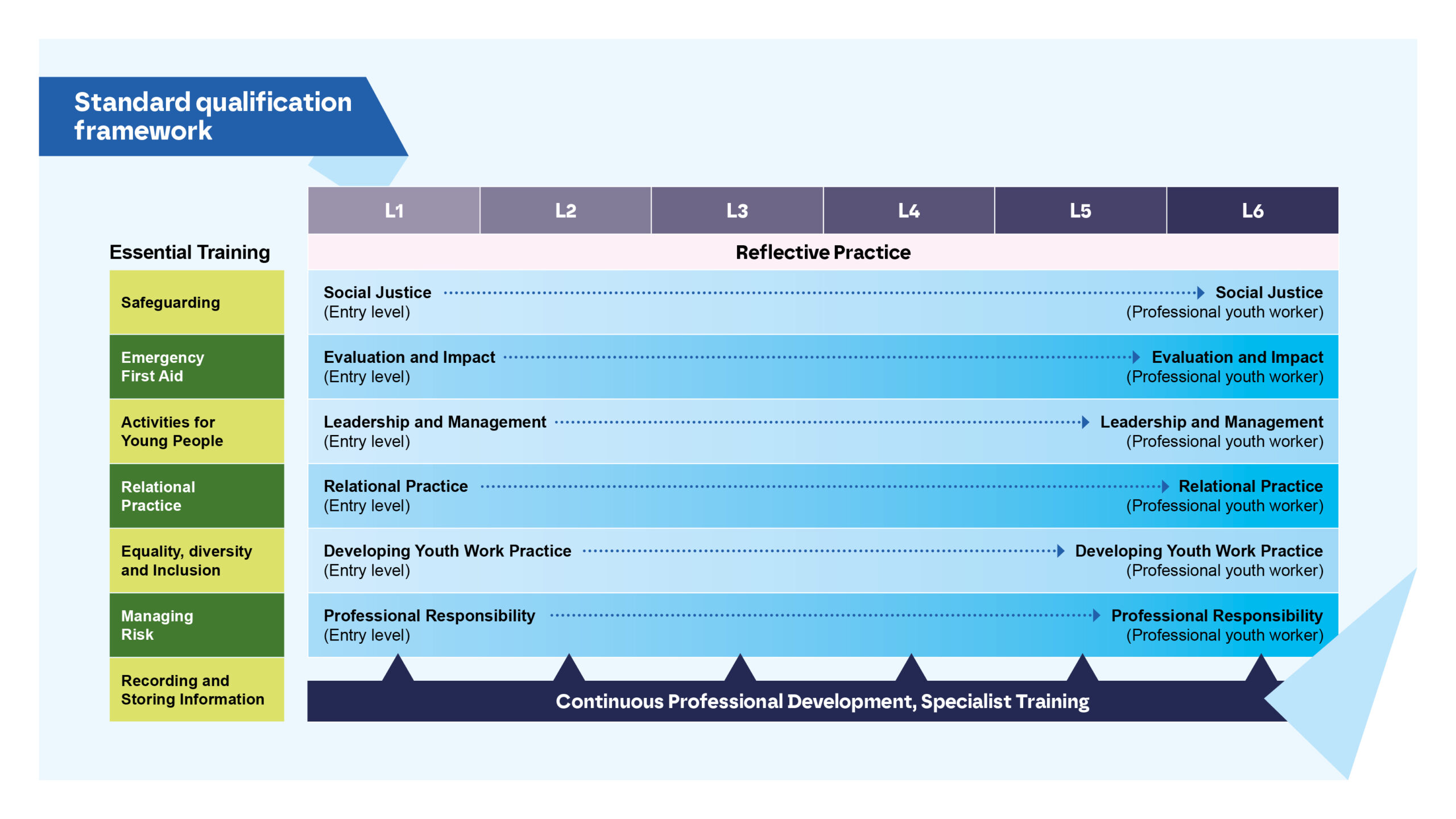
- modular learning to build essential youth work skills and enables completion of individual units as stepping-stones to qualifications
- clear progression from entry level to degree level, with Levels 1- 5 building competence, confidence and practical experience, and Level 6+ remaining the gold standard conferring professional status
- alignment with the National Occupational Standards, Practice and Safeguarding Standards, Youth Work Curriculum, and youth work values
- an ambition to introduce higher technical qualifications to support progression- subject to the outcomes of wider government education reforms
- more flexible, accessible and affordable training routes
- recognition of prior experience and learning
Professional recognition and the conditions for success
Professional recognition is essential for sustainability, supporting clearer standards, accountability and progression across the sector, and positioning youth work alongside other professions in education, social care and health.
Alongside qualification reform, we are working to improve the structural and regulatory conditions that support a resilient, high-quality youth work workforce. Our priorities include:
- broadening the Youth Worker Register beyond Level 6+ to promote greater consistency, quality and safety across the sector and to give all youth workers recognition for their skills and qualifications, and something they can be proud to be part of. This aligns with the National Youth Strategy ambitions set out by the government
- clarifying regulatory guidance within Local Authorities’ Statutory Duty to support a sufficient local youth work offer
- sharing models of good practice across local authorities and partners
- improving employer guidance and standards so youth workers are supported to deliver safe, high-quality practice
- expanding access to CPD to support retention, development and professional confidence
”“Reform of the qualification framework is vital to rebuild the youth work sector and meet the ambitions of the National Youth Strategy. We are working closely with awarding organisations, training providers, employers, funders and commissioners to develop the new qualifications which will help us build back the workforce at the speed needed to meet demand.
“The aim is to attract new people into this hugely rewarding profession, upskill the current workforce and create affordable, accessible routes into qualifications and training, while protecting youth work values and accrediting essential skills.”
Abbee McLatchie, Cyfarwyddwr Gwaith Ieuenctid/Dirprwy Brif Swyddog Gweithredol, Asiantaeth Ieuenctid Genedlaethol
When will the new framework be up and running?
We are working with the Awarding Bodies Network, Higher and Further Education institutions and youth work trainers to bring about the changes to the youth work qualifications.
An indicative timetable is set out below:
- The Level 1 Award in Youth Work (available from Medi 2026) is the first qualification within the reformed Standard Qualification Framework, providing an accessible introduction to youth work and a starting point for people exploring a career in the sector
- the reformed Level 2 qualifications are expected to be available from Autumn 2026
- a new Level 3 Technical Occupational Entry in Youth Support Work (Diploma) will launch on 1 Awst 2026 mapped to the Occupational Standard for Youth Support Worker Apprenticeship Framework*. It is anticipated that this qualification will become the mandatory qualification for the Youth Support Worker apprenticeship
- *Skills England has Occupational Standards for Youth Support Worker and Youth Worker. In time, NYA is planning to develop Occupational Standards for Levels 3-6 in Youth Work.
- we are working to ensure that there will be funded routes to qualification at Levels 2 – 6 and for training for volunteers, allowing workers to receive free or greatly subsidised training. The apprenticeship offers this already at levels 3 and 6, and once the Department for Education has completed its education reforms, we will look to create funded qualifications at Levels 2,3,4 and 5 – which could include a V-Level and Higher Technical Qualifications. We are also working to allow youth workers to access the proposed new Skills Levy and Lifelong Learning Entitlement to fund Youth Work Training
- from 2027, the NYA will publish an Annual Sector Qualifications Report tracking uptake, delivery capacity, outcomes and workforce impact.
Which awarding bodies accredit the new qualifications?
The Level 1 Award in Youth Work is available through the following awarding organisations from 1 Medi 2026:
| Awarding Body | Qualification Link |
| AIM Qualifications and Assessment Group | AIM Qualifications Level 1 Award in Youth Work (610/7448/2) |
| NCFE | NCFE CACHE Level 1 Award in Youth Work (610/7342/8) |
| NOCN Group | NOCN Level 1 Award in Youth Work (610/7394/5) |
| OCN London | Coming soon on ocnlondon.org.uk |
| Open Awards | Open Awards Level 1 Award in Youth Work (RQF) (610/7449/4) |
| Skills and Education Group Awards | SEG Awards Level 1 Award in Youth Work (610/7261/8) |
| Training Qualifications UK (TQUK) | TQUK Level 1 Award in Youth Work (RQF) (610/7486/X) Located under Health and Social Care here. |
| VETskills (VetSkill) | Coming soon on vetskill.com |
The Level 3 Technical Occupational Entry in Youth Support Work Diploma is available from 1 Awst 2026 through:
| Awarding Body | Qualification Link |
| AIM Qualifications and Assessment Group | AIM Qualifications Level 3 Technical Occupational Entry in Youth Support Work (Diploma) (610/6223/6) |
| NCFE | NCFE CACHE Level 3 Technical Occupational Entry in Youth Support Work (Diploma) (610/6209/1) |
| NOCN Group | NOCN Level 3 Technical Occupational Entry in Youth Support Work (Diploma) (610/6201/7) |
| Open Awards | Open Awards Level 3 Technical Occupational Entry in Youth Support Work (Diploma) (610/6237/6) |
| Skills and Education Group Awards | SEG Awards Level 3 Technical Occupational Entry in Youth Support Work (Diploma) (610/6187/6) |
””Youth work plays a vital role in supporting young people’s wellbeing, life skills and safety, but for too long it has been delivered under the radar, with scant funding or recognition.
The National Youth Strategy provided the mandate for a stronger and better qualified workforce and for recognising the value and impact of youth workers in the youth ecosystem, working alongside allied professionals in education, social care and health.
Qualification reform is essential to meet demand, but it must be part of a wider package of change across the youth sector. Lasting impact relies on clear sufficiency benchmarks being set out in the Statutory Duty to show what a properly resourced youth offer looks like - and on sustainable funding for Local Authorities to deliver it in partnership with the voluntary sector.
Alongside developing the revised Standard Qualification Framework we will continue to work with government, policy makers and the sector to help catalyse change locally and to promote models of good practice across local authority areas.”
Leigh Middleton OBE Prif Swyddog Gweithredol, Asiantaeth Ieuenctid Genedlaethol
Cyswllt
If you have any questions about the proposed new qualification framework please email: nya@nya.org.uk