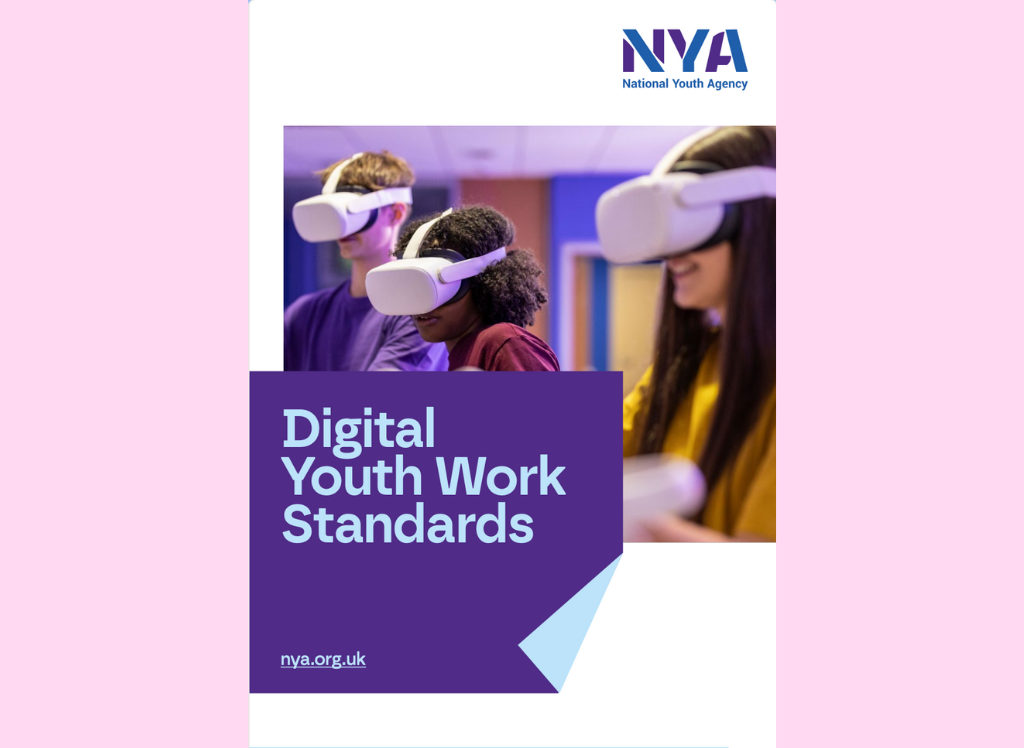

The National Youth Agency (NYA) has launched new Digital Youth Work Standards funded by the Department for Culture, Media and Sport (DCMS) to promote adoption and best practice of digital youth work across the sector. The publication of the Standards follows on from research by the NYA which reveals that only a quarter of youth workers surveyed had undertaken digital specific youth work training and fear of the unknown is a key barrier to delivering digital youth work.
Digital youth work involves the use of digital technologies and online spaces to connect with, engage, and support young people, incorporating digital activities, tools and topics into youth work services. Whether using Virtual Reality during a youth work session, discussing online safety during a football activity, or using a games console to facilitate conversations about healthy relationships, the core principles and values of youth work are the same as face-to-face youth work.
The research by the NYA into the digital skills and confidence of youth workers, commissioned by Fusion21 Foundation with support from the National Lottery Community Fund, highlighted the lack of knowledge and confidence in digital youth work across the sector, and clear need for training and support in this area. Key findings are:
- Only a quarter (24%) of those surveyed have taken part in digital specific youth work training and just a third (34%) believe they have the skills to deliver digital youth work
- Although two-thirds (67%) state that they understand what digital youth work is, there is no uniform or agreed definition amongst respondents. Additionally, a third (31%) think it must be delivered online.
- Few see it as an avenue to other forms of youth work – half (53%) think it isn’t as impactful as ‘traditional’ youth work, and one in five (19%) think it lacks appeal to young people.
- Fear of the unknown is a key barrier – as a third (36%) think digital is risky and complex.
The new Digital Youth Work Standards provide a quality framework to help build the skills and confidence of youth workers to integrate digital technologies into their work with young people.
With 99% of young people aged 12-15 regularly going online (Ofcom’s Children’s Media Literacy Report 2024) the resource aims to enable youth workers to engage young people using the technologies and online spaces that are already part of their daily life. The guidance also responds to barriers some young people face in accessing face-to-face youth work, for example those who are persistently absent from school, experiencing mental health challenges or neuro-disability. They also set out the laws and regulations that youth workers should consider, such as the Online Safety Act 2023.
Space Youth Services charity based in Exeter, Devon, is one of the projects cited in the report as leading the way in delivering digital youth work to 11-19 year olds. Their Online Youth Centre offers an alternative way to access youth work, through joining Space’s Discord server to chat, play games and get to know new people who they often go on to meet in-person through face-to-face delivery, which the centre also offers.
Matt Bakall, Senior Youth Support Worker in Charge, Space Youth Services, said:
“Space Virtual Youth Club, now in its fifth year, runs three evenings a week and provides a safe and inclusive place for young people to make new friends, have something to do, and have someone to talk to. Proven to be a safe place for young people who are neurodiverse and LGBTQ+ it recognises the need for support services for young people within rural communities that may not have access to youth work provision. Our sessions are supported by trained youth workers who also offer signposting.”
The NYA has developed the Digital Youth Work Standards in partnership with national youth sector experts, drawing upon their insights and experience of digital youth work practice, safeguarding and risk management, technology, data protection and information security, workforce and quality.
Bex Pink, National Digital Innovation Lead, National Youth Agency, said:
“Some fear that digital threatens the traditional, when in-fact it is the opposite. Digital tools and technologies can help reach more young people – we know online platforms make it easier to connect with young people who may otherwise be unable to access face to face provision.”
“Online spaces can create a sense of belonging in the same way as a youth club can – where young people can connect and be part of a support network that transcends geographical boundaries. It’s vital that youth work services evolve with the needs of young people and by embracing digital, the youth work sector can enhance its impact, support wider audiences and better serve the complex needs of young people today.”
The Digital Youth Work Standards were launched at Tata Consultancy Services’ (TCS) Pace Port in London, to an audience of youth work pioneers in digital youth work. TCS has provided various support including hosting a workshop for the steering group involved in the creation of the Standards.
You can find out more about digital youth work and access the Digital Youth Work Standards here.