
Self-Care and Wellbeing Resources for Youth Workers
“You don’t have to be a therapist to be therapeutic”
– Carl Rogers
Youth work is powerful, but it can also be emotionally demanding.
This space is designed to support your wellbeing – whether you’re a volunteer, trainee or professional.
Prioritising wellbeing is not only beneficial for youth workers themselves but also for the young people they serve; a ‘youth worker’ who is healthy and well-supported is better equipped to build positive relationships, create safe spaces, and effectively support young people’s development. By investing in the wellbeing of youth workers, organisations can ensure a sustainable and impactful youth work sector.
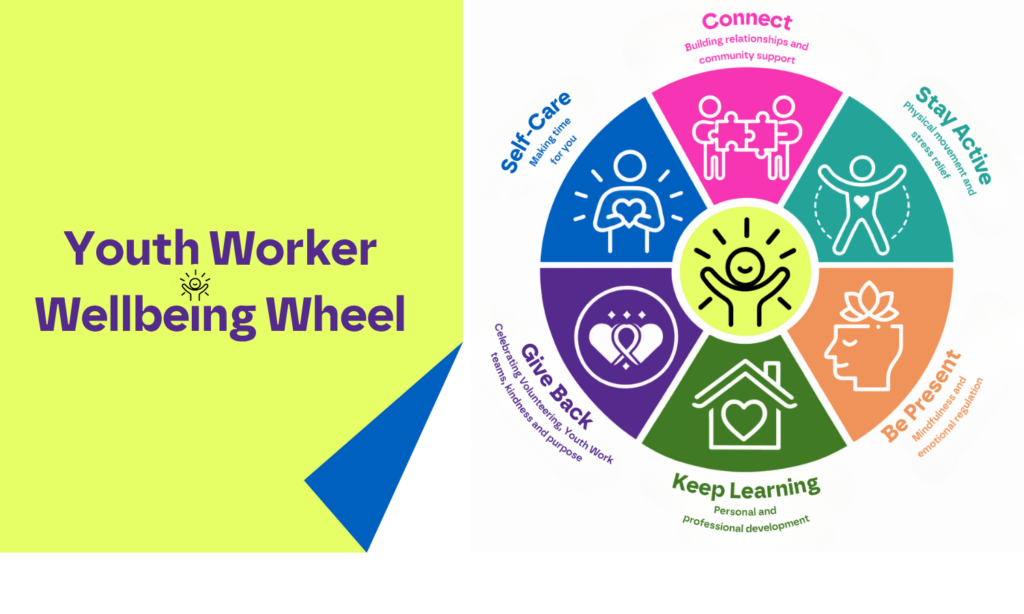
An adapted version of the Six Ways to Wellbeing has been used curate a range of practical tools, resources and challenges, click on the relevant title below to access.
Connect - Focus: Building relationships and community support
- Peer Learning circles
- Whether online or in person—offer youth workers a vital space to connect, reflect, and recharge. These regular gatherings help build a sense of community and shared understanding, reminding workers that they’re not alone in the challenges and joys of the job. Peer learning circles create safe, supportive spaces where youth workers can share experiences, decompress, and learn from one another. To keep the sessions engaging and meaningful, consider rotating facilitators and introducing different themes such as gratitude, burnout recovery, or joy in the job. This encourages fresh perspectives and helps everyone feel included and empowered. These circles not only strengthen wellbeing but also promote resilience, confidence, and connection across the team.
- Buddy systems and regular check ins with peers
- Buddy systems are a simple but powerful way to help youth workers feel connected, encouraged, and supported in their wellbeing. Pairing colleagues together creates space for regular check ins, shared reflection, and gentle accountability around self care goals, reminding youth workers that support is always in reach.
These buddy partnerships can offer:- Encouragement during busy or challenging periods
- A listening ear when workers need to talk things through
- Motivation to maintain healthy routines and boundaries
- To help keep conversations meaningful and fun, consider providing conversation starters, prompt cards, or even wellbeing bingo activities. These tools can spark reflection, deepen connection, and make check ins feel more engaging.
- Buddy systems are a simple but powerful way to help youth workers feel connected, encouraged, and supported in their wellbeing. Pairing colleagues together creates space for regular check ins, shared reflection, and gentle accountability around self care goals, reminding youth workers that support is always in reach.
- Supervision sessions with experienced professionals
- Regular supervision sessions with experienced professionals offer youth workers a dedicated space to pause, reflect, and feel supported in their practice. These sessions create a confidential environment where workers can explore challenges, process emotions, celebrate successes, and receive guidance from someone who understands the realities of youth work.Supervision helps to:
- Strengthen professional confidence
- Build emotional resilience
- Improve decision-making‑making and safeguarding practice
- Support overall wellbeing and growth
- Deepen reflective practice by giving workers time to think about their approaches, explore what’s working, and identify areas for learning and development
Embedding consistent, high‑quality supervision within youth work teams ensures staff feel heard, valued, and equipped to provide safe, effective support to young people.
- Regular supervision sessions with experienced professionals offer youth workers a dedicated space to pause, reflect, and feel supported in their practice. These sessions create a confidential environment where workers can explore challenges, process emotions, celebrate successes, and receive guidance from someone who understands the realities of youth work.Supervision helps to:
- Team activities
- Team activities help youth workers build trust, boost morale, and strengthen connection. Even small, shared experiences can create a sense of belonging and support, making teams feel more resilient and better able to care for the young people they serve.
- “Rose-Thorn-Bud” reflective activity, Rose-Thorn-Bud” is a reflective exercise, often used in teams, that encourages participants to identify positive aspects, challenges, and potential opportunities related to a project, experience, or situation. It uses a botanical metaphor to categorise feedback: “Rose” represents what went well, “Thorn” signifies challenges or areas needing improvement, and “Bud” represents potential or things to look forward to. Click on the following link for instructions and templates Roses, Buds and Thorns | SessionLab.
- Creative activities like art, writing, music, and journaling improve team wellbeing by reducing stress, encouraging expression, and strengthening connection—helping people feel calmer, more engaged, and more connected at work.
- Build themed retreats into ‘away days’ (e.g., “Nature & Nurture,” “Creative Calm”) with activities like yoga, journaling, nature walks, cookery and art therapy. This type of activity promotes mindfulness in the moment, reflection and a way to quiet the mind.
- Reflection – build time for team reflection using creative tools like storytelling, metaphor cards, or visual journaling into supervision sessions. Use art or collage to explore emotional landscapes.
- Team strength mapping – team strengths mapping – move away from a deficit approach to acknowledging the wealth of experience, knowledge and skills.
- Team activities help youth workers build trust, boost morale, and strengthen connection. Even small, shared experiences can create a sense of belonging and support, making teams feel more resilient and better able to care for the young people they serve.
- Challenges – Team challenges build connection, spark motivation, and strengthen collaboration. Working toward a shared goal helps teams feel united and energised. Examples include, Try something new, Kindness bingo, Healthy eating week, choose a campaign to support
- Team activities help youth workers build trust, boost morale, and strengthen connection. Even small, shared experiences can create a sense of belonging and support, making teams feel more resilient and better able to care for the young people they serve.
- Digital Wellbeing
- Healthy relationships, online and offline, are an essential part of digital wellbeing. Using technology should strengthen real connections rather than replace them, encouraging us to be intentional in how we communicate instead of getting lost in endless scrolling. This means focusing on meaningful interactions that build trust and understanding, whether through messages, video calls, or in-person time. It also involves being aware of how digital comparison can impact our emotions and perceptions of our relationships, and taking steps to protect our wellbeing by staying grounded in genuine, supportive connections.
- When spending long hours on a laptop, it can also help to create healthier communication habits with technology itself. For example, using focused work methods such as the Pomodoro Technique, working in short, intentional bursts followed by regular breaks, can reduce digital fatigue and help prevent screen time from becoming overwhelming.
- Connecting
- Connecting with youth workers locally, regionally, nationally and internationally helps build a wider sense of community, shared purpose, and support. These networks offer fresh ideas, encouragement, and perspective—reminding youth workers that they’re part of something bigger and never working alone. Contact your local Regional Youth Work Unit. The NYA’s Youth Work Connect community of practice is an accessible space for youth workers and allied sector professionals to engage in critical reflection, peer learning, and expert led dialogue on youth work issues. Find out more here Youth Work Connect and Insight Sessions – National Youth Agency
- Black Ballad
- Black Ballad is a UK based lifestyle platform that seeks to tell the human experience through eyes of black British women, offering a range of resources and connections in support including Mental Health & Wellness.
- Conversation Guide
- If you’re at risk of burnout or have burnt out, this guide will help you address the causes with your manager. Provide relevant examples alongside potential solutions. Share only what you’re comfortable with and be open to exploring alternatives.
- Muslim Women’s Network
Stay Active - Focus: Physical movement and stress relief
- Yoga sessions, nature walks, dance, sports
- Movement‑based activities—such as yoga, nature walks, dance, and sports—are powerful for wellbeing because they help release stress, boost mood, and reconnect the body and mind. These activities support emotional balance, improve energy levels, and offer moments of joy, grounding, and community. Explore what is available in your area and online.
- Digital Wellbeing
- Move your body, reduce passive screen time, is an important part of digital wellbeing. It encourages us to replace passive scrolling with more active and intentional choices, such as going for a walk, stretching, or simply taking regular breaks away from screens. By stepping back from devices, we create more opportunities to be physically active and present in our daily lives. It also involves using tools and apps that support healthier screen habits, helping us build routines that prioritise movement, balance, and overall wellbeing.
- For people spending long periods working at a laptop, movement breaks are especially important. Pairing work with structured routines like the Pomodoro Technique can help build regular opportunities to stand, stretch, hydrate, or move between focus sessions. Small breaks may help reduce stiffness, improve posture, and lessen the physical tension that often contributes to headaches and migraines.
- 10 things
- Think of 10 things you have enjoyed doing in your life – small or big, it might be planting a flower, taking a walk, roller skating or traveling. Put a date next to the last time you did the activity. Think of one activity that you could commit to in the next day, week, month.
- Themed retreats into ‘away days’ (e.g., “Nature & Nurture,” “Creative Calm”)
- Activities like yoga, journaling, nature walks, cookery and art therapy. This type of activity promotes mindfulness in the moment, reflection and a way to quiet the mind.
- Youth Wellbeing Hub– National Youth Council for Ireland.
- ‘’If you are a youth worker or work with young people this wellbeing hub has been developed with your needs in mind’’. The Hub offers a range of resources, seminars, mindfulness, meditation and much more!
- Visit Your Wellbeing Hub – National Youth Council of Ireland
Be Present - Focus: Mindfulness and emotional regulation

- Grounding techniques (e.g., 5-4-3-2-1, breathwork)
- Grounding techniques help youth workers manage moments of stress by bringing attention back to the present moment. They create a sense of steadiness and calm, making it easier to regulate emotions and feel more in control during busy or challenging sessions. For youth workers, grounding can be a quick, effective way to pause, reset, and continue the work with more clarity and ease.
- How to use grounding techniques:
- 5–4–3–2–1 Method: Notice five things you can see, four you can touch, three you can hear, two you can smell, and one you can taste.
- Deep Breathing: Slow, steady breaths help reset the nervous system and reduce overwhelm.
- Physical Grounding: Place your feet flat on the floor, feel the chair beneath you, or hold an object with texture—anything that anchors your body in the moment.
- Sensory Breaks: Use a calming scent, sip a warm drink, or stretch to reconnect with your body.
- How to use grounding techniques:
- Priory | 10 Minute Body Scan Meditation
- Box Breathing Relaxation Exercise | 5 Minutes Beginner Pace | Anxiety Reduction Pranayama Technique
- Grounding techniques help youth workers manage moments of stress by bringing attention back to the present moment. They create a sense of steadiness and calm, making it easier to regulate emotions and feel more in control during busy or challenging sessions. For youth workers, grounding can be a quick, effective way to pause, reset, and continue the work with more clarity and ease.
- Holding meetings or supervision outside
- Holding meetings or supervisions outdoors can boost wellbeing by creating a calmer, more open atmosphere. Fresh air, movement and natural surroundings help reduce stress, spark clearer thinking and make reflective conversations feel more relaxed and grounded. For youth workers, stepping outside can offer a welcome reset and support more honest, energising discussions.
- Complete the stress cycle
- The body can become stuck in ‘’stress mode’’, encourage youth workers to complete the stress cycle when faced with ongoing pressure. Completing the stress cycle helps release that built‑up tension so the nervous system can return to a calmer state. Simple activities—like movement, breathwork, positive social connection, or even having a good cry or a good laugh—can signal to the body that the stress has passed. Creative expression and long hugs (around 20 seconds) can also help restore balance and relieve emotional strain. NB. Check that someone is happy to give or receive a hug is important because it ensures comfort, consent, and emotional safety. Everyone has different boundaries, and asking first shows respect, avoids assumptions, and helps create a supportive environment where youth workers feel in control of their own personal space.
- Release through breath
- Positive social interaction
- Have a good cry
- Affection – long hug (20 seconds)
- Have a good laugh
- Be creative
- How to manage and reduce stress | Mental Health Foundation
- The body can become stuck in ‘’stress mode’’, encourage youth workers to complete the stress cycle when faced with ongoing pressure. Completing the stress cycle helps release that built‑up tension so the nervous system can return to a calmer state. Simple activities—like movement, breathwork, positive social connection, or even having a good cry or a good laugh—can signal to the body that the stress has passed. Creative expression and long hugs (around 20 seconds) can also help restore balance and relieve emotional strain. NB. Check that someone is happy to give or receive a hug is important because it ensures comfort, consent, and emotional safety. Everyone has different boundaries, and asking first shows respect, avoids assumptions, and helps create a supportive environment where youth workers feel in control of their own personal space.
- Digital Wellbeing
- Mindfulness and attention in the moment are key aspects of digital wellbeing. It helps us stay present by reducing unnecessary interruptions from notifications and alerts, allowing us to focus without constant distractions. By avoiding multitasking between screens and real-life interactions, we can give our full attention to what is happening around us. Using technology with intention rather than out of habit supports greater awareness, improves concentration, and helps us engage more meaningfully in everyday experiences.
- Laptop-heavy routines can easily encourage constant multitasking and overstimulation, both of which can increase stress and mental fatigue. Creating focused work periods through techniques such as Pomodoro can support deeper concentration while also giving permission to fully step away during breaks
- Resources & tools:
- Pomodoro Technique https://youtu.be/aQ_xKuXo0D0?si=ZMQcbhqEAz-MIoIN
- Resources & tools:
- Calm kits with sensory tools
- Create Calm Kits to support youth workers during moments of high stress—either for their own grounding or to use with young people. These kits can include simple sensory items such as stress balls, essential oils, grounding cards, colouring pages, playdough, kaleidoscopes, calming music, chewing gum, or lollipops. By engaging the senses—sight, touch, smell, sound, and taste—Calm Kits offer quick, practical ways to regulate emotions and bring the nervous system back to balance. You can find inspiration for building your own kit in resources like the Sensory Comfort Kit for Anxious Times from MindWell. Sensory comfort kit for anxious times – MindWell
- Mindfulness workshops and wellness apps
- Mindfulness workshops and wellness apps offer youth workers simple, accessible ways to pause, reset, and look after their mental wellbeing. Workshops provide guided space to learn techniques that reduce stress and improve focus, while apps make it easy to build small, supportive habits into everyday life. Together, they help youth workers stay grounded, calm, and more resilient in the face of a demanding role.
- How to choose the right one?
- Mindfulness workshops and wellness apps are widely available through community groups, local wellbeing services, online and trusted app stores. When choosing one, look for options that feel accessible, evidence‑based, and aligned with your needs. A good workshop or app should be easy to follow, respectful of personal boundaries, and designed to support wellbeing—not add pressure. Checking reviews, asking colleagues for recommendations, and trying a short taster session can help you find the approach that feels right for you. If you’re unsure which workshop to choose, look for one that feels approachable, is delivered by trained facilitators, and offers practical techniques that fit your needs and working style.
- ‘’Self-care for LGBTQIA+ Lives, navigate queer life confidently with self-care tools, expert-created resources, and affirming mental wellness journeys’’ Voda | The LGBTQIA+ Mental Wellbeing App
- Headspace is a popular mental health app designed to help you stress less, sleep better, and feel more balanced. It offers guided meditations, relaxing sleep sounds, mindfulness exercises, and expert‑led programs that support everyday wellbeing. With tools for managing anxiety, improving sleep, and building healthy habits, Headspace provides simple, science‑backed support you can use anytime you need a reset. Mental Health App for Meditation & Sleep – Headspace
- Decompression zones in the workplace
- Setting up a neuro-inclusive decompression or wellness zone means creating a quiet, comfortable, and private space where employees can relax and recharge. While UK law doesn’t require a dedicated wellness room, employers must provide “suitable and sufficient” rest facilities under the Workplace (Health, Safety and Welfare) Regulations 1992.
- Key Requirements: – A space to rest and eat meals- Clean, well-ventilated, and appropriately lit environment- Accessible facilities for all employees, including those with disabilities
- Best Practice Tips:-Include calming décor and soft seating-Ensure privacy and quiet-Offer resources for mental wellbeing (e.g. mindfulness tools, metaphor cards)- Include soft lighting, calming music, and sensory items.
- This would also be a great facility for young people!
- Setting up a neuro-inclusive decompression or wellness zone means creating a quiet, comfortable, and private space where employees can relax and recharge. While UK law doesn’t require a dedicated wellness room, employers must provide “suitable and sufficient” rest facilities under the Workplace (Health, Safety and Welfare) Regulations 1992.
- How to reframe stressful situations
- Cognitive reframing is a simple but powerful technique that helps you change how you interpret stressful situations. By shifting the way you think, you can reduce the emotional intensity of stress and feel more in control. Research shows that reframing works because your stress response is often triggered by how you perceive a situation rather than the situation itself. See How to Use Cognitive Reframing for Stress.
- To reframe a stressful moment, start by noticing the unhelpful thought, challenge whether it’s fully accurate, and create a more balanced interpretation. For example, shifting “I can’t cope with this” to “This is too difficult, but I can take it one step at a time” helps ease the stress response and builds resilience. Visit Road2Recovery’s Cognitive Behavioral Technique: Reframing resource.
- Practised regularly, cognitive reframing helps youth workers navigate pressure with more clarity, steadiness, and self‑compassion.
Keep Learning - Focus: Personal and professional development
- Organisational support
- Youth work organisations have a powerful role to play in supporting the wellbeing of their staff. By offering practical training, accessible resources, and fostering a culture that values mental health, organisations can help youth workers feel confident, supported, and grounded in their practice.
- Managers are especially important in shaping this environment. Creating a space that is safe, warm, open, and honest allows teams to feel valued and understood. When youth workers feel supported and accepted, they are better able to offer the same level of care and consistency to the young people they work with. To strengthen this culture of support, explore our Intermediate Supervision eLearning module here: Supervising Youth Workers: Building Culturally Competent, Reflective, and Effective Teams – National Youth Agency
- Resilient Leadership
- Resilient leadership helps managers stay steady, adaptable, and supportive during challenging times. According to the Centre for Creative Leadership (CCL), resilient leaders can respond to setbacks with flexibility, maintain emotional balance, and model a positive, forward‑looking mindset for their teams. By embracing practices that strengthen physical, mental, emotional, and social resilience, leaders create healthier workplaces where youth workers feel supported, confident, and more able to thrive.
- Try the 8 Steps for More Resilient Leadership | Resilience Practices | CCL
- Digital Wellbeing
- Curiosity, growth, and informed digital use are central to digital wellbeing. It encourages us to actively train our algorithms by intentionally engaging with the kind of content we want to see more of, while staying aware that every click, like, and share shapes our feed. By reducing exposure to low-value or emotionally draining content, we can create a more positive and purposeful online environment. At the same time, building digital literacy helps us understand how platforms are designed to capture attention, allowing us to make more informed choices about how we interact with technology. Learning how screen habits affect our bodies and minds is also part of digital wellbeing. Understanding the impact of prolonged laptop use can help us to make healthier and informed choices As artificial intelligence becomes more common in everyday life, learning how to use AI critically and responsibly is an important part of digital wellbeing. AI tools can support creativity, productivity, accessibility, and learning, but they can also sometimes generate inaccurate, biased, or misleading information. Developing digital literacy means understanding how algorithms and AI shape the content we see online, while building habits such as fact-checking information, questioning sensational content, and using critical thinking alongside technology. A balanced approach to AI helps us use it as a positive tool to support learning and wellbeing without relying on it uncritically.
- Tips:
- Unfollow or mute content that doesn’t support your learning or wellbeing
- Follow accounts that teach, inspire, or challenge you positively
- Use your feed as a learning tool, not passive consumption
- Fact-check information before sharing on social media
- Tips:
- Curiosity, growth, and informed digital use are central to digital wellbeing. It encourages us to actively train our algorithms by intentionally engaging with the kind of content we want to see more of, while staying aware that every click, like, and share shapes our feed. By reducing exposure to low-value or emotionally draining content, we can create a more positive and purposeful online environment. At the same time, building digital literacy helps us understand how platforms are designed to capture attention, allowing us to make more informed choices about how we interact with technology. Learning how screen habits affect our bodies and minds is also part of digital wellbeing. Understanding the impact of prolonged laptop use can help us to make healthier and informed choices As artificial intelligence becomes more common in everyday life, learning how to use AI critically and responsibly is an important part of digital wellbeing. AI tools can support creativity, productivity, accessibility, and learning, but they can also sometimes generate inaccurate, biased, or misleading information. Developing digital literacy means understanding how algorithms and AI shape the content we see online, while building habits such as fact-checking information, questioning sensational content, and using critical thinking alongside technology. A balanced approach to AI helps us use it as a positive tool to support learning and wellbeing without relying on it uncritically.
- Monthly reflection cards
- Monthly reflection cards give youth workers a simple, structured way to pause and think about their practice. They encourage workers to notice what’s going well, recognise challenges, and celebrate small wins. These regular moments of reflection help build confidence, reduce overwhelm, and support more intentional, grounded youth work. Questions can be formatted into categories like hope, strengths, connection and growth. Here are a few questions that can be adapted for use:
- “What brought me hope this week?”
- “Where did I set a boundary that protected my energy or wellbeing?”
- “What moment brought me joy or made me smile?”
- “What’s one thing I achieved or feel proud of?”
- “What interaction with a young person felt meaningful to me?”
- “What challenged me this week, and what did I learn from it?”
- “When did I feel most supported by my team?”
- “What’s one small win I want to carry into next week?”
- “What helped me feel grounded or calm?”
- “What’s something I’d like to do differently next time?”
- Monthly reflection cards give youth workers a simple, structured way to pause and think about their practice. They encourage workers to notice what’s going well, recognise challenges, and celebrate small wins. These regular moments of reflection help build confidence, reduce overwhelm, and support more intentional, grounded youth work. Questions can be formatted into categories like hope, strengths, connection and growth. Here are a few questions that can be adapted for use:
- Working conditions
- Positive working conditions—such as manageable workloads, safe spaces, and supportive leadership—play a crucial role in youth worker wellbeing. When the environment feels safe, fair, and sustainable, youth workers have more energy, clarity, and confidence to do their best work with young people.
- Visit the following websites for further guidance:
- Explore the Youth Work Code of Ethics
- Exploring the Youth Work Code of Ethics helps strengthen clarity, confidence, and purpose. When youth workers understand the values and boundaries guiding their practice, it reduces stress, supports better decision‑making, and helps them feel more grounded and protected in their role.
- Mental Health First Aid Awareness and Training
- Mental Health First Aid (MHFA) training helps workplaces build a more supportive, informed, and mentally healthy environment. MHFA England provides evidence‑based courses that teach people how to spot early signs of poor mental health, start supportive conversations, and signpost colleagues to appropriate help. Their training empowers managers and teams to reduce stigma, strengthen wellbeing, and create safer, more resilient workplace cultures.
- Emerging Youth Workers
- play a vital role in supporting young people through challenging experiences. Trauma-Informed Care & Essential Self-Care for Youth Workers provides a foundation for understanding how trauma impacts behaviour, relationships, and wellbeing—while also equipping youth workers with practical tools to care for their own emotional and mental health. This learning helps new practitioners build confidence, protect their wellbeing, and create safer, more supportive environments for the young people they serve.
- Stress management
- Understanding stress—whether as an individual or as an organisation—means recognising the early signs, identifying what triggers pressure, and developing healthy ways to respond. When people and workplaces learn about stress together, they build resilience, support one another more effectively, and create a healthier environment where everyone can thrive. The following links provide advice, guidance and learning opportunities.
- Managing Stress | Making Choices | DEAL | Samaritans
- Managing stress in your organisation | NCVO
- Stress in the Workplace | Factsheets | CIPD
- Emerging Youth Workers
- Mental Health First Aid (MHFA) training helps workplaces build a more supportive, informed, and mentally healthy environment. MHFA England provides evidence‑based courses that teach people how to spot early signs of poor mental health, start supportive conversations, and signpost colleagues to appropriate help. Their training empowers managers and teams to reduce stigma, strengthen wellbeing, and create safer, more resilient workplace cultures.
- Samaritans
- Samaritans Training and Engagement Programmes for Workplaces | Samaritans, offers a series of eLearning courses designed so participants can learn flexibly at a time that suits them.
- National Youth Agency learning
- The NYA offers a range of learning events from Youth Work Connects and Insights, through to online and in person training. Sign up to the Network to find out more.
- NYA academy
- The NYA Academy aims to enhance the skills and confidence of Youth Work practitioners do they can safely and effectively support young people. Visit the link above to access training and qualifications.
- Safeguarding & Risk Management Hub – National Youth Agency
- Mae'r Hwb yn darparu canllawiau, cefnogaeth, cyngor a mynediad at adnoddau hyfforddi i bob sefydliad ac unigolyn sy'n gweithio gyda phobl ifanc – boed eich bod yn wirfoddolwr, yn ymddiriedolwr, yn weithiwr ieuenctid neu'n arweinydd sefydliadol.
- The British Red Cross
- The British Red Cross offers a wide range of free wellbeing resources to help people manage stress, build resilience, and feel more connected in everyday life, including online learning and workshops. Visit Wellbeing Support | Activities & ideas | British Red Cross
- Understanding compassion fatigue
- Compassion fatigue – youth workers may feel some shame or guilt for feeling like this, this is not unusual. It is just the body telling you that them they may need to put the following in place:
- Feelings of exhaustion, feeling mentally, emotionally and physically tired on a regular basis
- Prolonged sadness
- No longer finding pleasure in your work
- Difficulty concentrating
- Unable to switch off from work
- Feelings of hopelessness – nothing you do matters
- Feeling detached from work and colleagues
- Intrusive thoughts about the young people’s experiences
- Consider the following:
- A healthier work/life balance
- Take some annual leave
- Debrief with your colleagues/managers more
- Remind yourself the relationship is enough, you don’t have to solve the young person’s problems
- Find playfulness or joy outside of work
- Connect more as a team in a fun way
- Check if you have healthy boundaries within your work and home life
- If a young person’s experiences have triggered some of your own experiences – maybe speak to your line manager, GP or a mental health professional
- Know it’s ok to move on or leave
- Compassion fatigue – youth workers may feel some shame or guilt for feeling like this, this is not unusual. It is just the body telling you that them they may need to put the following in place:
- Diverse Minds
- A Podcast series from award winning Leyla Okhai exploring a range of topics including mental health, wellbeing and equality. Visit Podcast Archives – Diverse Minds
Give Back - Focus: Celebrating Volunteering, Youth Work teams, kindness, and purpose

- Kindness campaigns
- Kindness campaigns can have a powerful impact on a youth worker (and young peoples) wellbeing. Simple acts of kindness—whether giving, receiving, or witnessing—can lift morale, reduce stress, and strengthen connection within teams. Creating intentional moments of kindness helps build a culture where people feel valued, seen, and supported. These small gestures can make a big difference in helping youth workers feel grounded and appreciated in their day‑to‑day practice. Click on the links for further guidance.
- Kindness matters guide | Mental Health Foundation
- Random acts of kindness | Mental Health Foundation
- Volunteers
- Volunteers are vital to youth work because they broaden what services can offer and bring their own energy, skills and support to young people. However, volunteers from the same community may face blurred boundaries—such as being recognised locally, managing expectations outside sessions, or balancing confidentiality—which can create pressure and affect their wellbeing. Feeling valued is essential, as appreciation boosts motivation, confidence and long‑term commitment. You can show this by offering regular thanks, sharing positive feedback, involving volunteers in decisions, providing supportive supervision and training, and recognising their contributions through simple gestures that help them feel respected and part of the team.
- Visit Volunteers’ Week – to find out how you can celebrate volunteers.
- Digital Wellbeing
- Contribution, kindness, and community are important aspects of digital wellbeing. It encourages us to use online spaces in ways that uplift others and contribute positively, being thoughtful about what we share and how it may affect people. This includes avoiding reactive or habit-driven posting and instead communicating with intention and respect. It also supports us in choosing to engage with online communities that feel constructive, supportive, and aligned with our values, helping to create a more positive digital environment for everyone.
- Digital wellbeing also means modelling healthy technology habits for others. This might include respecting boundaries around availability, encouraging breaks during online meetings, or sharing practical wellbeing strategies such as the Pomodoro Technique with colleagues. Creating healthier digital cultures together can make screen-heavy environments feel more balanced, supportive, and sustainable.
- Creating birthday boxes or personalised care packages for team members
- Curate small individual birthday boxes – this doesn’t need to be a costly exercise. Fill with items like herbal teas or hot chocolate, affirmation cards, cozy socks, essential oils like lavender, journal and a pen, scented candle, bath salts/body wash/lotion, stress ball or fidget toy, dark chocolate, lip balm, and a self-care challenge. Personalise to demonstrate that you understand your team member.
- Ieuenctid Llundain
- The London Youth Minds Matter toolkit is designed to support youth workers with practical, accessible resources that strengthen wellbeing, confidence, and reflective practice. It brings together guidance, tools, and activities that help youth workers care for themselves while delivering the best support to young people. This toolkit is a trusted companion for staying grounded, connected, and resilient in the work.
- Access to counselling and EAPs (Employee Assistance Programmes)
- Providing youth workers with access to confidential counselling and Employee Assistance Programmes (EAPs) is an essential part of supporting their mental and emotional wellbeing. These services offer immediate, professional assistance for anyone experiencing stress, who might be overwhelmed, or experiencing other personal or work‑related challenges.
-
- Talk through difficult experiences in a safe, private space
- Receive short‑term emotional support and guidance
- Access specialist services when needed (e.g., financial advice, mental health support, legal information)
- Build coping strategies that strengthen resilience and wellbeingCounselling and EAPs can help youth workers:
- Making these services visible, accessible, and stigma‑free helps ensure youth workers feel supported not only in their roles, but as whole people. Visit the following links to find out more.
- How to implement an Employee Assistance… | CIPD HR-inform
- Preventing stress – Managing work-related stress – Acas
- Employee Assistance Programme: Employer Guide
- HMRC Employment Income Manual
Self-care - Focus: Making time for you

- Self-care practices (nutrition, hydration, sleep)
- Self‑care means taking intentional steps to support your wellbeing. This could involve improving your diet, starting a new hobby, spending time with family and friends, finding ways to relax, or becoming more active. OpenLearn offers a wide range of articles, tips, and learning resources to help you make self‑care part of your everyday life.
- Visit Learn to live well with self-care on OpenLearn | OpenLearn – Open University
- Digital Wellbeing
- Physical health, rest, and digital balance are essential parts of digital wellbeing. It helps protect our physical health by encouraging clear boundaries around screen use, especially during rest and sleep, and by helping us recognise when scrolling becomes automatic rather than intentional. By building healthier routines that include regular breaks from technology and more mindful engagement online, we can support both our bodies and minds. Simple strategies such as setting screen time limits, curating your digital space, and using social media with purpose can reduce overuse, while occasional breaks, like a short social media detox, can help reset habits and improve overall wellbeing.
- When using laptops and other screens, helpful habits include adjusting posture, reducing glare, staying hydrated, limiting screens before sleep, and creating screen-free moments throughout the day to allow the body and mind to properly rest and recover.
- Visual journaling and metaphor cards
- Visual journaling and metaphor cards offer youth workers a creative way to explore emotions, reflect on experiences, and process stress. Structured journaling approaches can support emotional regulation and trauma recovery by giving people a safe, guided way to express difficult thoughts and feelings.
- From a trauma‑informed (TIP) perspective, journaling doesn’t have to be written—using images, colours, or symbols can make self‑reflection feel more accessible and less overwhelming. Visual methods help untangle emotions, create clarity, and support ongoing healing.
- The Power of Journaling: Structured Approaches for Trauma Recovery | CPTSDfoundation.org
- How to Journal from a TIP perspective – Safety Net UK
- Self-soothe boxes
- A self‑soothe box is a simple but powerful tool that can help to manage difficult feelings, calm minds, and feel grounded during stressful moments. Filled with comforting, meaningful items, it acts as a personal “first‑aid kit” for emotional wellbeing.
- Creating a self‑soothe box is easy and can be completely personalised. Start with any small box or container, then add items that help engage the senses and bring comfort—things like a favourite scent, a soft object, a grounding note from a friend, photos, music playlists, or positive affirmations. The goal is to include things that help you feel safe, calm, and connected when emotions feel overwhelming.
- How to make a self-soothe box – Best For You
- Wellness Action Plan
- Wellness Action Plans are simple, practical tools that can help you support your mental health at work. Mind has created a range of resources and templates for both individuals and managers to promote wellbeing. You don’t need to be experiencing a mental health problem to benefit—using a Wellness Action Plan helps you and teams identify the positive steps that keep you feeling well, especially during times when things are going well, so you can draw on them whenever they’re needed.
- Visit Free wellness action plan template | Mind
- Ieuenctid Llundain
- The London Youth Minds Matter toolkit is designed to support youth workers with practical, accessible resources that strengthen wellbeing, confidence, and reflective practice. It brings together guidance, tools, and activities that help youth workers care for themselves while delivering the best support to young people. This toolkit is a trusted companion for staying grounded, connected, and resilient in the work.
- NHS 5 Steps to mental wellbeing
- The NHS 5 Steps to Mental Wellbeing offer simple, evidence‑based actions that can help people feel more positive and get the most out of life. These steps encourage us to connect with others, be physically active, keep learning, give to others, and pay attention to the present moment. Together, they provide a practical framework that youth workers can use to support their own wellbeing and build healthy habits that strengthen resilience over time. Click on the following links for more information.
- 5 steps to mental wellbeing – NHS
- Self-help – NHS
If you are experiencing an emotional crisis please remember that you are not alone and support is available right now.
If you feel overwhelmed, unsafe, or unable to cope, reach out immediately to someone who can help. You can contact the Samaritans for 24/7 confidential emotional support by calling 116 123, available free from any phone.
If you prefer to text, you can reach the Shout Crisis Text Line by texting 85258 for free, confidential support at any time.
If you are in immediate danger or feel unable to keep yourself safe, please call 999 or go to your nearest A&E department for urgent medical help.
You spend so much of your time caring for young people—please reach out and let someone care for you too.
