
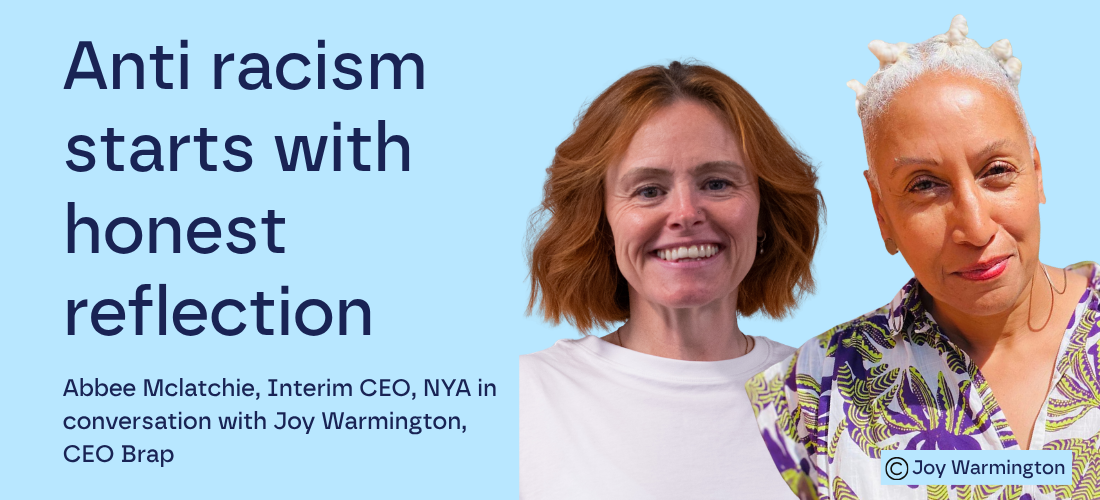
A conversation between Abbee McLatchie, Interim CEO, National Youth Agency and Joy Warmington, CEO of Brap, explored what it means for the youth work sector to move beyond statements of intent and develop anti-racist practice as something lived, relational and embedded in everyday youth work.
Rather than treating racism as an occasional incident to be managed through policy, both speakers returned to the need for deeper learning, reflective practice and the courage to sit with discomfort. As Joy put it, “Many organisations confuse a commitment to equality and diversity with capability.” Believing in equality, she argued, is not the same as knowing how to recognise and respond to the ways racism shapes relationships, decisions, expectations and organisational culture.
Being mindful of language was another are point made by Joy: “I don’t believe there are races, there’s one race – a human race.” Youth workers, she believes, can disrupt common belief systems by helping young people understand that ideas of separate races are social constructs, created and sustained in ways that oppress and marginalise groups. “I hate the word difference, because it sets up the idea that there is something normal and something else that’s different,” she explained.
Both agreed that anti-racism was not about performative celebration, but about being able to detect racism already operating within organisational assumptions and systems and act on what is noticed. Joy explained: “Anti-racism is not just simply about an organisational commitment; it’s also a relational practice. The real test lies in how they share power, how decisions are made, whose voices are heard and believed and listened to, and whose concerns are interrogated and minimised.”
Anti-racist practice requires people to be honest about the assumptions they carry, the emotions that arise when race is discussed, and the ways everyone can reproduce racism if they do not notice it, argued Joy. Abbee echoed this through her own example from safeguarding training, where a trainer challenged her reluctance to name race directly.
Abbee highlighted the responsibility of practitioners, managers and supervisors to create spaces where youth workers can interrogate their own belief systems and understand what they bring into their work. “If we can’t talk about it, we can’t change it,” she said, linking anti-racist learning to the foundations of youth work itself: relationship, challenge, reflection and learning alongside young people.
The discussion also challenged the idea of simply creating “safe spaces”. Joy explained that she prefers to talk about “brave spaces”, because “growth rarely happens without discomfort” and because what feels safe for one group may marginalise another. Abbee connected the brave theme to the Solidarity Network webinars which the NYA delivers in partnership with UK Youth, providing a forum for youth workers to talk openly about racism, discomfort and difference, and to practice holding conversations that may feel difficult. “There’s not a one-size-fits-all approach,” she said. “It should be the principles and values that we bring into those spaces that are universal, but the way we hold those conversations with young people should reflect us and them and the situation they find themselves in.”
Listening to lived experience was another key thread, but both speakers were clear that listening is only meaningful if it leads to learning and action. Joy warned that organisations are often interested in collecting stories but fail to learn from them. “Lived experience is often seen as an end in itself,” she said, “but it’s really only the beginning of something.” Young people, she noted, often understand racism in ways adults overlook; they notice exclusions, stereotypes and expectations placed on them. Abbee built on this by stressing the importance of feedback and accountability: young people need to know not only that they have been heard, but what has changed as a result.
When discussing how youth workers can challenge racism in the moment, Abbee described the importance of asking questions, staying relational and helping young people explore where ideas have come from and how they may land with others. Joy advised that the aim shouldn’t be to win the argument but to keep learning: “Curiosity is far more powerful condemnation,’ she warned.
Both speakers emphasised that having the confidence to do this can’t be achieved through a one-day course, but as something that should be built into team meetings, supervision, training and the “fabric of the organisation”. Joy agreed, while adding that deeper learning is essential because language, history and power all shape how racism is reproduced.
The final part of the conversation focused on sustaining change. For both Joy and Abbee, the challenge is to move anti-racism from a visible initiative into everyday culture – the work that happens when no one is looking.
The conversation closed on a hopeful note. Joy asked how youth work can help “create the conditions for a different type of humanity to flourish,” while Abbee reflected that youth work is inherently hopeful because it believes change is possible and that practitioners can “hold the hope of a better future for young people.”
Want to explore further? The Quiet Revolution, hosted by Joy Warmington, asks what happens when we stop performing anti-racism and start living it, drawing on brap’s 25 years of practice. Listen and subscribe: Apple Podcasts or Spotify.
Also check out the NYA’s Equity, Equality, Diversity, Inclusion and Belonging Standards for the youth sector which provides guidance on creating fair, accessible and inclusive youth work environments where every young person feels seen, heard and valued.
Co-hosted by UK Youth, the NYA and the Network of Regional Youth Work Units, Standing in Solidarity: Supporting the Youth Sector brings the youth sector together for shared learning, reflection, collective care and action.
